Hot Holding Food Temperature in Staff Canteens: Time, Temperature and Logs
Key takeaways
- Hot holding food temperature on a canteen serving line comes down to one rule: keep hot food truly hot, keep cold food truly cold, and control time as well as temperature.
- Bain maries, steam tables and hot holding cabinets are for holding food that is already hot, not for reheating food that has cooled down.
- Refill in small batches timed to each break wave, label every pan with the time it went out, and never pour new food onto old.
- Check with a probe thermometer at set rounds and log each reading together with the corrective action.
During lunch in a staff canteen, many pans wait on the line longer than people expect. HR, facility teams and head chefs keep asking the same things: what should the hot holding food temperature be, how long can cooked food sit out, and when does it have to go? This guide covers hot holding and cold holding, how to use bain maries and steam tables, refilling by shift, probe thermometer logs and handling leftovers after service. It draws on public sources you can check, and it is general planning guidance, not legal advice.
What hot holding food temperature should a canteen line keep?
The core principle is that hot food must stay properly hot for the whole time it is on display and cold food must stay properly cold, because microorganisms multiply quickly in the middle temperature range often called the danger zone. Your limits should come from government guidance and your kitchen's food safety plan, not from guesswork or the sight of steam.
Thailand's Ministry of Public Health announcement on the sale of ready-to-eat food in food sale premises (see the sources at the end) requires boiled, curried, stewed and steamed ready-to-eat food to be held hot at above sixty-three degrees Celsius. If such food is kept at room temperature during preparation or sale, it must not stay there for more than two hours and must be reheated properly before serving. Food that is not cooked, such as salads and cut fruit, should be kept in a fridge or chiller below five degrees Celsius, or at room temperature for no more than two hours.
The World Health Organization's Five Keys to Safer Food advise keeping cooked food piping hot, above sixty degrees Celsius, before serving, refrigerating cooked food promptly, preferably below five degrees Celsius, and not leaving cooked food at room temperature for more than two hours. Check with your local public health officer which rules apply to your premises.
How long can cooked food sit on the serving line, and when should you discard it?
Set a time limit for each pan in advance, label the pan with the time it left the kitchen, and discard it as soon as the time is up or a reading fails, whether or not the food still looks fine.
- Time labels: use a colour for each break wave and write the time the pan left the kitchen.
- No topping up: swap in a fresh pan instead of pouring a new batch onto what is left, otherwise nobody can tell how long the food has been out.
- Stay inside the ceiling: many kitchens set their own limit shorter than the official maximum to allow for transport time.
- Log discards: record the dish and the amount thrown away so the next batch can be adjusted. For ways to cut leftovers, see our guide to factory canteen food waste management.
How should you use a bain marie, steam table or hot holding cabinet?
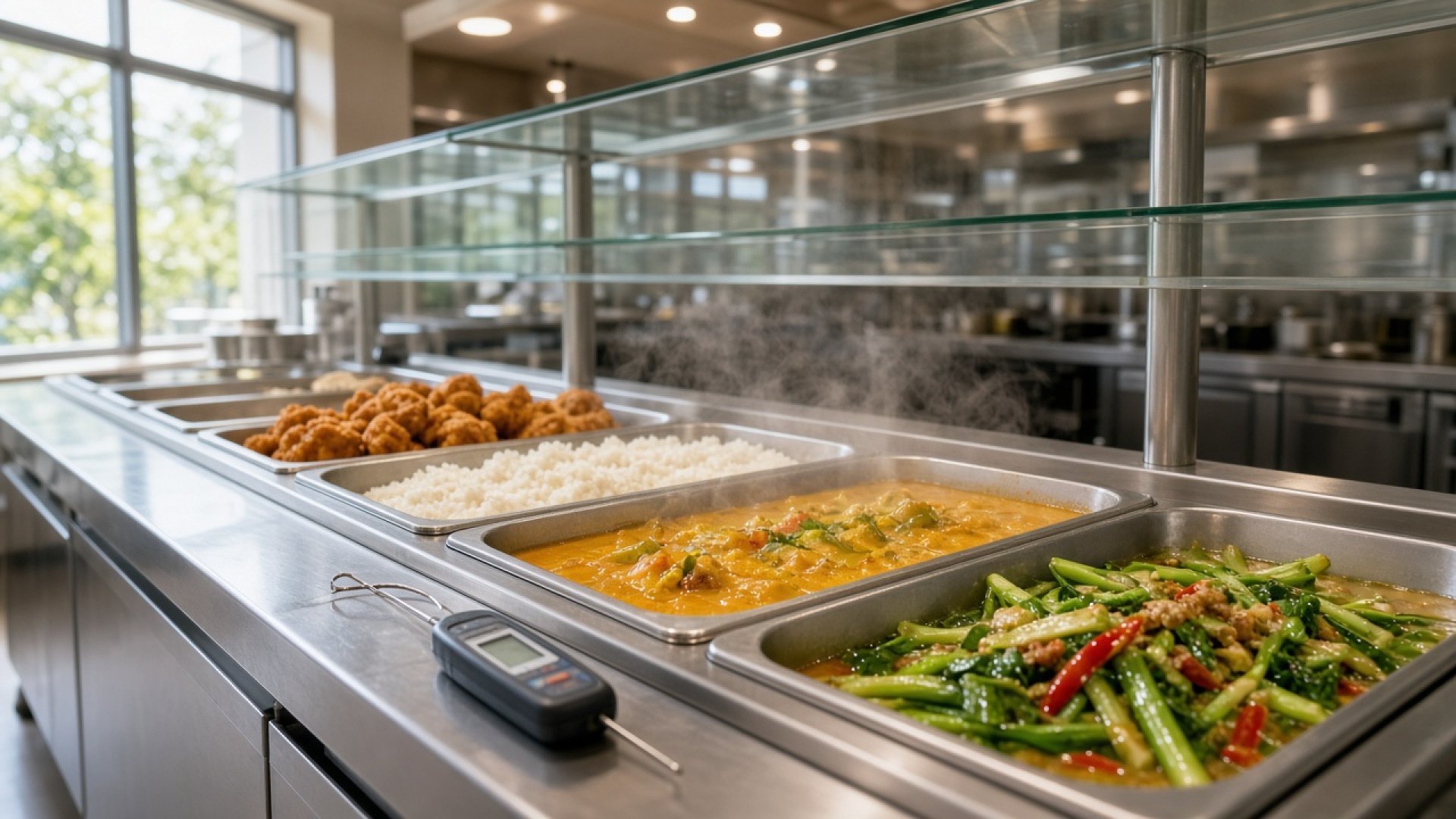
Buffet food warmers, water-bath bain maries or steam tables, and hot holding cabinets are made to keep food that is already cooked and hot at temperature. They are not designed to bring cooled food back up to a safe temperature.
- Switch the unit on and let it heat up before loading food, and check the water level as the manual describes.
- Use shallow pans sized to each break; they turn over faster than deep pans.
- Use lids or sneeze guards and stir food from time to time.
- Keep backup pans in a hot holding cabinet behind the line instead of on an open bench.
- Report units that heat unevenly. For equipment planning, see our canteen kitchen equipment guide.
How do you refill by shift and lunch wave?
Plan cooking around the real break times of each shift, cook several small batches, and send a fresh pan to the line before the next wave arrives rather than cooking once and leaving everything out for the whole break.
- Build the break schedule with HR and time each dish's pan to match it.
- Curries and soups can be cooked in larger batches; fried dishes and stir-fried vegetables work better in smaller, more frequent batches.
- Have line staff signal the kitchen before a pan runs out.
- On a quiet night shift, use smaller pans or plate meals to order.
For queue planning and staggered breaks, read how to manage the canteen lunch rush, and for matching kitchen staff to peak times, see canteen staff shift scheduling.
How should you keep a probe thermometer temperature log?
Use a probe food thermometer, measure at the centre of the pan or the thickest part of the food at set rounds, and record the result and any corrective action on the same log every day. A good log shows which unit or dish keeps causing problems.
- Clean the probe before and after every pan.
- Check thermometer accuracy as the manufacturer recommends and keep a spare.
- Write corrective actions in advance, for example reheat thoroughly or discard according to the plan.

Sample fields for a serving line temperature log
| Log field | What to record | Why it matters |
|---|---|---|
| Date, shift, break wave and checker | When it was measured and by whom | Compare by wave and assign responsibility |
| Dish and pan position | Menu name and spot on the line | Spot weak units |
| Time the pan went out | Matches the pan's time label | Control time alongside temperature |
| Reading and pass or fail | Compared with the limit in your plan | Decide on the spot |
| Corrective action | Reheat, swap the pan or discard | Proof the problem was fixed |
For a checklist that covers the whole day from opening to close, see our canteen daily food safety checklist.
How should cold food such as salad and fruit be held on the line?
Uncooked food such as salads, cut fruit and chilled desserts should sit on a chilled well or ice bed that holds the cold, or be time-limited at room temperature according to your plan. Put it out in small batches and keep it away from hot pans. For checking quality at the source, see canteen ingredient receiving inspection.
How should leftovers be cooled and handled after service?
Food that has already been on the line should be handled according to your food safety plan, and many kitchens discard it once the line closes. Cooked food that never went out should be divided into shallow containers to cool quickly and refrigerated promptly, as the WHO advises.
- Do not leave a large pot out to cool by itself, and do not overpack the fridge so cold air cannot circulate.
- Label each container with the dish, date and time cooked, and use older stock first.
- When using it, reheat thoroughly and do not reheat more than once.
How do factory, hospital and international school canteens differ?
The temperature principles are the same, but serving rhythm, diners and risk points differ, so batch timing and checks should be adapted to each site.
| Site | Serving pattern | Focus |
|---|---|---|
| Factory canteen | Several shifts and break waves arriving all at once | Batch cooking per wave and the same checks on night shift as on day shift |
| Hospital canteen | Staff canteen plus patient meals sent to wards | Control transport time and use heated trolleys or insulated boxes |
| International school | Children of different ages eating in year-group sittings | Short holding times, clear allergen labels and adults supervising the line |
For more on the three settings, read canteen management in factories, hospitals and international schools, and for menus staff actually want to eat, see lower-sugar, lower-fat, lower-salt staff canteen menus.
Myths and facts
- Myth: If steam is still rising, the food is hot enough. Fact: Steam does not tell you the real temperature; measure with a thermometer.
- Myth: With the warmer switched on, food can stay out all day. Fact: You must control both temperature and time, and a warmer will not bring cooled food back up to temperature.
- Myth: Food must cool completely before it goes in the fridge. Fact: The WHO advises refrigerating cooked food promptly; shallow containers help it cool faster.
Frequently asked questions
How long can cooked food stay at room temperature?
Thailand's Ministry of Public Health announcement on ready-to-eat food and the WHO Five Keys both say no more than two hours. Many kitchens therefore set a shorter limit of their own.
Can a bain marie be used to reheat cold food?
No. Bain maries and hot holding cabinets are for keeping food that is already hot at temperature. Food that has cooled should be reheated thoroughly on a stove first and then moved to the line.
How often should food on the line be temperature-checked?
Check when a pan goes out, at set rounds during service and before the next wave arrives. The exact frequency should be written into your kitchen's food safety plan.
Can hot food go straight into the fridge?
In principle, yes. The WHO advises refrigerating cooked food promptly; divide it into shallow or small containers first and do not overpack the fridge.
How can TJ FAVOR GROUP help?
TJ FAVOR GROUP provides canteen management, staff meals and event catering. If your organisation is reviewing batch cooking and temperature control on its serving line, our team is happy to talk it through and share initial thoughts.
Sources
- Thailand Ministry of Public Health announcement on criteria, methods, quality control and hygiene for the sale of ready-to-eat food in food sale premises (Royal Gazette, June, Buddhist Era year two thousand five hundred sixty-six): announcement document via the Bangkok Metropolitan Administration Food Sanitation Division website
- World Health Organization: Five Keys to Safer Food
Contact the team
TJ FAVOR GROUP is a Bangkok-based company with more than seven years of food-service experience, providing canteen management, staff meals and event catering, with tableware and equipment provided, no extra service charge and a twenty-four-hour hotline. If you are setting up hot holding and temperature control for your canteen, see our canteen management service page, read about us or contact the team.
Call 063-878-8169 / 087-746-0044 / 096-949-6622
Chat with TJ Favor on LINE @tjfavor