Canteen Management for Factories, Hospitals and International Schools: A Food-Service Guide to Minimarts, Cafes and Coffee Corners
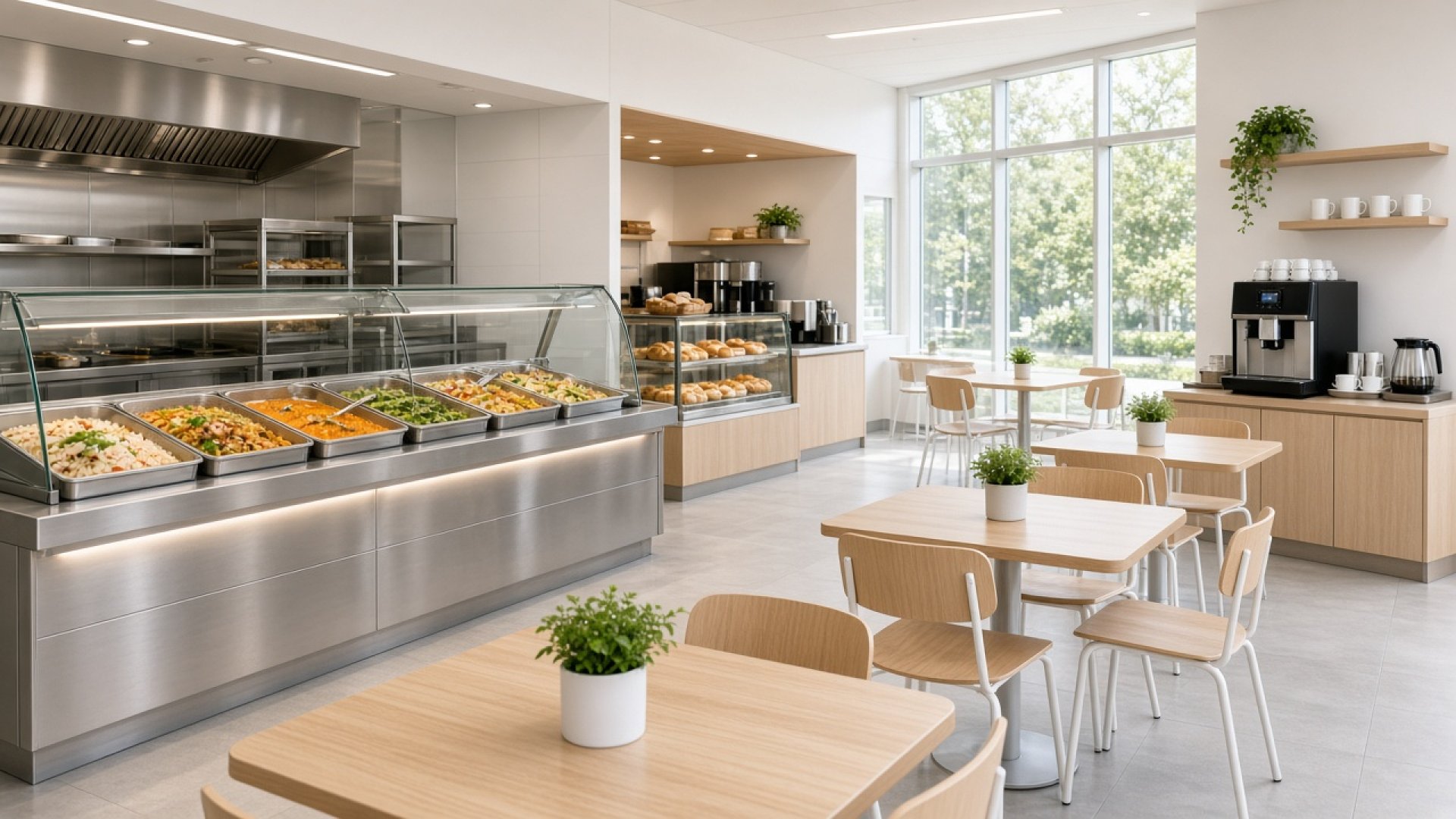
Key takeaways
- Factories, hospitals and international schools share the same canteen management basics, but their users, hours and risks are very different, so a system cannot simply be copied from one to another.
- Workplace food service is more than the canteen: the staff shop or minimart, cafe, coffee corner and pantry should be planned together.
- Before hiring a provider, write down who uses each point, when, which risks must be controlled and how results will be measured.
Many organisations start thinking about canteen management for factories, hospitals and international schools with the same question: can one type of provider run them all? The short answer is that the basics are the same (hygiene, menus, queues and satisfaction), but the day-to-day details differ a lot. This is the first article in our series on food-service management. We compare the three settings, explain the supporting outlets (staff minimart, cafe, coffee corner and pantry) and finish with a checklist for HR, procurement and facility managers. General guidance is kept separate from what TJ FAVOR GROUP states on its website.
What does workplace food service include?
Workplace food service is every point where staff, visitors or students get food and drinks on site, not only the canteen. Each point needs different management (general guidance).
| Outlet | Main role | What to manage |
|---|---|---|
| Canteen | Main meals for staff or students | Rotating menus, portions, queues, kitchen hygiene and food waste |
| Staff shop or minimart | Snacks, drinks and daily essentials | Product range, stock, expiry dates, payment and opening hours |
| Cafe | Freshly made drinks, bakery items, a place to rest or meet | Consistent taste, machine care and speed at peak times |
| Coffee corner and pantry | Self-service drinks and snacks | Restocking, cleaning, cup washing and controlling usage |
Planning all outlets together avoids duplicate menus and makes the budget easier to control.
How does canteen management differ between factories, hospitals and international schools?
The difference lies in the users, the hours and the risks to control. Factories need speed and energy for shift work, hospitals serve several user groups almost all day, and international schools look after children with many different dietary needs (general guidance).
| Point | Factory | Hospital | International school |
|---|---|---|---|
| Main users | Production and office staff | Staff, outpatients, relatives and visitors | Students of all ages, teachers, parents |
| Hours | By shift, including night shift | Almost all day | Short breaks set by the timetable |
| Main goal | Fast service, filling meals, budget control | Clean, calm and orderly, suitable for many users | Child safety, food allergies and age-appropriate meals |
| Typical extra outlets | Staff shop, coffee corner near the line | Cafe, convenience shop, gift kiosk | Snack bar, parents' cafe |
| Decision makers | HR, procurement, facilities | Management, nutrition team, facilities | School operations team, sometimes parent representatives |
Factories: speed and shift continuity
A factory canteen serves many people during short breaks, so the serving line, tray return and refill rounds must keep up with the queue. Night-shift staff should get hot food and choices close to the day shift. A staff shop in a factory often needs to open around shift changes. For menus, see factory staff menu planning.
Hospitals: many user groups and strict cleanliness
Hospital canteens and shops serve staff on rotating shifts, outpatients and waiting relatives, so they need light, mildly seasoned options and quick drinks. Importantly, inpatient meals are the job of the hospital's own kitchen and nutrition team, which follow separate rules. A canteen or cafe provider should agree clearly which parts it covers.
International schools: allergies and diverse students
International schools have students of many nationalities and ages. Several schools publish nut-free policies and use student cards instead of cash in the canteen so parents can follow spending. Providers need ingredient labels, vegetarian choices and allergy-aware meals, and they work closely with teachers at lunchtime. For special diets, see halal and vegetarian options in a staff canteen.
How should a staff shop or minimart be run?
Start from what users actually need, then keep stock, expiry dates and payment under control. A good staff shop saves people a trip off site (general guidance).
- Ask what people want: survey users and match the range to the site. A factory may focus on drinks and ready-to-eat food, while a school may need to exclude some items under school policy.
- Control expiry dates: use first in, first out (FIFO) and check shelves regularly.
- Match opening hours to use: shift changes, breaks or the end of the school day.
- Payment: consider cashless payment or staff cards to shorten queues and simplify sales records.
- Hygiene and safety: keep fridge temperatures under control, shelves clean and non-food items apart from food.
- Listen to feedback: add shop questions to your satisfaction survey; see the canteen satisfaction survey guide.
What does a cafe, coffee corner or pantry need?
Three things: drinks that taste the same every day, a clean machine and area, and supplies that never run out. These small points shape how staff feel about the workplace every day (general guidance).
- Name who restocks coffee, milk, sugar, cups and snacks, and on what schedule.
- Clean the machine and drip tray as the manufacturer instructs, and log daily cleaning.
- Give cup washing and waste their own space so the corner does not become a dirty spot.
- Offer alternatives such as tea, water or unsweetened drinks for people who do not drink coffee.
- A staffed cafe should plan its people around peaks, such as before work starts and after lunch.

Which hygiene standards apply to all three?
Canteens in schools, factories and hospitals are all assessed with the same Department of Health food sanitation checklist for canteens. It is based on the ministerial regulation on hygiene of food-selling premises and covers the dining area, the food preparation area and food handlers (source: Bureau of Food and Water Sanitation, Department of Health, Thailand).
- Hospitals have extra rules: kitchens that cook for inpatients follow a separate standard, and the Department of Health's GREEN & CLEAN Hospital programme also covers food sanitation.
- Cafes and food shops in the building: may need to follow the Department of Health's SAN or SAN Plus criteria; check with the local authority.
- Food handlers: every point that prepares or serves food should have staff trained in food sanitation as the law requires.
Read more in canteen hygiene standards in Thailand. Requirements can change, so check the current version with the Department of Health or your local authority before relying on it.
Checklist before hiring a canteen and food-service provider (HR, procurement, facilities)
Cover every outlet in your brief and put it in the TOR or service agreement (general guidance).
- List the outlets you need: canteen, staff shop, cafe, coffee corner or pantry.
- State the user groups, hours and rough number of users for each.
- State site-specific limits, such as a school nut-free policy or a hospital scope that excludes inpatient meals.
- Ask for the menu plan, cleaning plan and food-waste approach.
- Ask about payment systems, sales reporting and stock control.
- Request sanitation and food-handler training records if your organisation requires them.
- Set measures such as satisfaction, queue time and hygiene audit results, and review them regularly.
For TOR, contract and KPI guidance, see canteen management outsourcing: a guide for HR and procurement.
How can TJ FAVOR GROUP help, according to its website?
The website states that TJ FAVOR GROUP manages canteens for factories, offices, workplaces and schools. The points below come from the service and home pages of tjfavor.com.
- Canteen management designed as a good staff benefit, so the company can focus on its core business.
- Over seven years of restaurant experience and ten restaurant branches; based in Bangkok.
- For company events, the catering page says plates, cutlery, glasses and other tableware are provided, there is no extra service charge, and bookings need only two days' notice.
- Free consultation and free quotation.
The website does not give details about hospital or international-school canteens, cafes or coffee corners. If you are planning these outlets, please ask the TJ FAVOR GROUP team directly to discuss the scope first.
Frequently asked questions about canteen management for factories, hospitals and international schools
Can one canteen provider serve every type of site?
In principle yes, but menus, opening hours and risk controls must be adapted to each site. Ask whether the provider has run similar sites and request a site-specific plan.
What is the difference between a staff welfare shop and a factory minimart?
In practice the terms are often used interchangeably. A welfare shop stresses the staff benefit, while a minimart describes a shop with shelves and a convenience-store style checkout.
What is the difference between a coffee corner and a pantry?
A coffee corner focuses on drinks, while a pantry is a small kitchen area for drinks, snacks and reheating food. Both need a named person for restocking and cleaning.
Does a hospital canteen have to cook inpatient meals?
Not necessarily. Inpatient meals are usually handled by the hospital's own kitchen and nutrition team under separate standards, so agree the scope clearly in the contract.
Can TJ FAVOR GROUP run a hospital or international-school canteen?
The website lists canteen management for factories, offices, workplaces and schools but gives no details for hospitals or international schools. Please contact the team to ask directly.
Talk to TJ FAVOR GROUP about canteen and food-service management
If you are planning a canteen, staff shop or coffee corner, send us the type of site, number of users, hours and the outlets you need. Our team will be glad to advise and prepare a quotation for your organisation.
- LINE: @tjfavor (with the @)
- Phone: 063-878-8169 / 087-746-0044 / 096-949-6622
- Email: tjfavorgroup@gmail.com
- Website: tjfavor.com
See the canteen management service page (Thai), our English home page, or contact the team.