Canteen Daily Food Safety Checklist: Before Opening, During Service and After Closing, for Factories, Hospitals and International Schools
Key takeaways
- A practical canteen daily food safety checklist works well in three parts: before opening, during service and after closing.
- Every item comes from the World Health Organization (WHO) Five Keys to Safer Food.
- Factories, hospitals and international schools use the same principles but focus on different risks, and someone responsible should sign the record every day.
Canteen food passes through many hands before it reaches the plate, and a single slip can make a lot of people unwell. This article sets out a canteen daily food safety checklist that a team can actually follow every day, from opening the kitchen and serving lunch to closing down, plus the points to stress in factories, hospitals and international schools. It is written for HR, procurement and kitchen supervisors. The content is general guidance based on WHO and Thailand's Department of Health; information about TJ FAVOR GROUP comes from our website.
Why does a canteen need a daily food safety checklist?
Routine kitchen tasks are easy to skip on a busy day. A checklist makes sure the key steps are done every time and leaves a record you can look back on. When something goes wrong, the organisation can find the cause faster (general guidance).
A daily checklist does not replace standards or the law; it is the tool that helps a team follow them day to day. For the Thai ministerial regulation and the Department of Health canteen inspection form, read our article on canteen hygiene standards in Thailand.
What are the WHO Five Keys to Safer Food?
They are basic food-handling principles published by the World Health Organization for consumers and food handlers worldwide, to help prevent foodborne disease. Every item in this checklist comes from these five keys. The table turns each key into canteen tasks.
| WHO key | Example canteen checklist item |
|---|---|
| Keep clean | Soap at every hand-wash sink; wash hands before touching food |
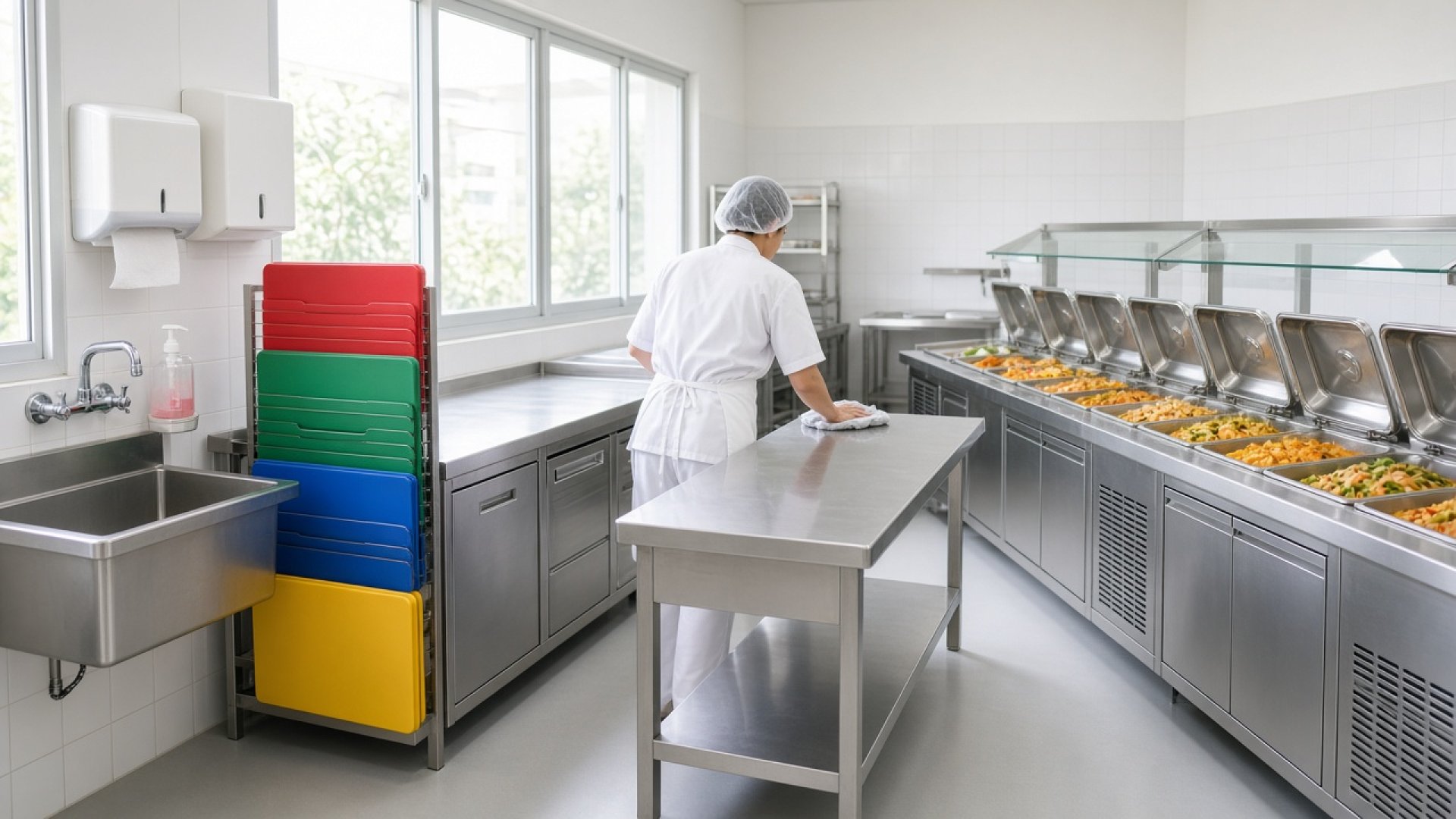
| Separate raw and cooked | Colour-coded boards and knives; raw food stored on lower shelves |
| Cook thoroughly | Use a food thermometer to check meat, poultry, eggs and seafood |
| Keep food at safe temperatures | Log fridge and hot-holding temperatures |
| Use safe water and raw materials | Check deliveries and expiry dates; wash fruit and vegetables |
Canteen daily food safety checklist: what to check before opening
Before opening, check three things: people, ingredients, and the area and equipment. It takes little time but stops most problems at the start of the day (general guidance).
Food handlers
- Clean uniform, apron and hair cover; short nails; no jewellery on hands.
- Ask about symptoms before the shift. Anyone with diarrhoea, vomiting, fever or a cut on the hand should not handle food, and everyone washes hands with soap before starting.
Ingredients and deliveries
- Check the condition, colour, smell and expiry date of deliveries. Chilled and frozen goods should still be cold on arrival.
- Store stock first in, first out (FIFO) and label it with the delivery or preparation date.
Area and equipment
- Check that fridges and freezers are within the limits the kitchen has set, and write the readings in the log.
- Prep tables, boards, knives and containers are clean, with separate sets for raw and cooked food.
- Hand-wash sinks have soap, there are no pests, and cleaning chemicals are stored away from food.
What should be monitored during service?
Service is the busiest, most rushed time, so food temperature, cross-contamination and the cleanliness of the serving line need constant attention. Assign someone to check in rounds rather than waiting for a problem (general guidance).
Keep hot food hot and cold food cold
WHO explains that microorganisms can multiply very quickly when food is kept at room temperature. Canteens should use hot-holding trays for hot dishes and chilled units for salads and fruit, check temperatures in rounds, and set a clear rule that food left out longer than the kitchen's time limit is thrown away, never mixed with fresh food.
Prevent cross-contamination
Use a separate serving spoon for each dish and never add fresh food to old food left in the same tray. Staff who handle money or clear plates should not switch to serving without washing their hands, and cut fruit or salad should be served with tongs.
Serving line and allergen information
Food trays should have lids or sneeze guards, labels showing the dish name and common allergens such as peanuts, shrimp, milk, eggs or soy, and serving spoons for shared dishes. For more, see our article on halal, vegetarian and special diets in the staff canteen.

What needs to be done after closing?
After closing is when the kitchen gets ready for the next day: handle leftovers, clean and sanitise equipment, separate waste and close the daily log. Skip it, and the problems show up the next morning (general guidance).
- Leftovers: food that has been on the serving line should not be kept to serve again. Food that was never put out should be cooled quickly, covered, dated and refrigerated.
- Clean and sanitise: wash containers, boards and food-contact surfaces, sanitise them and let them dry on racks off the floor. Clean floors, drains and stoves.
- Waste and food scraps: separate food waste from other rubbish, close the bins and clean around the bin area. See our guide to food waste management for factory canteens.
- Close the log: the shift leader checks every item is done, signs, and notes anything the next shift must fix.
What belongs on a weekly and monthly checklist?
Besides daily tasks, set longer-cycle checks for things that are not needed every day but must not be forgotten. The frequency depends on kitchen size and the agreement with the provider (general guidance).
- Deep-clean under kitchen equipment and the extractor hood.
- Clean fridges and chillers; inspect and clean the grease trap.
- Look for signs of pests and book the pest-control company on schedule.
- Check thermometer accuracy and review the daily logs for items that are often missed.
How do factories, hospitals and international schools differ?
All three use the same food safety principles, but the people they feed, their service hours and their main risks are different. The checklist should add items for each type of organisation (general guidance).
| Organisation | Common risk points | Items to add to the checklist |
|---|---|---|
| Factory | Large volumes, several shifts, food waiting between break slots | Check temperatures every break slot; check the night-shift kitchen as closely as the day shift |
| Hospital | Staff, patients and relatives; some people are more vulnerable to unsafe food than others | Keep patient-meal steps separate as the hospital requires; be strict about handwashing and food-handler health |
| International school | Children of different ages and cultures, and students with food allergies | Check ingredient labels, use separate utensils for allergy meals, and follow the school's food policy |
For a wider comparison of how these canteens are run, read canteen management for factories, hospitals and international schools.
What are common canteen food safety myths?
Some beliefs sound reasonable but lead teams to overlook real risks (general guidance).
- Myth: food that looks fine and does not smell is safe. Fact: many germs cannot be seen or smelled, so time and temperature must be controlled rather than judged by eye.
- Myth: wearing gloves means no handwashing. Fact: gloves get dirty just like hands; wash before putting them on and change them when switching tasks.
- Myth: the fridge kills germs. Fact: WHO notes that cold slows the growth of microorganisms and some still grow in the fridge, so food should not be stored too long.
Who should sign the checklist, and what should HR ask the provider for?
The staff at each station tick the checklist, the shift leader or head chef checks and signs it at the end of the day, and the organisation should spot-check the records from time to time. Clear roles stop the checklist becoming mere paperwork (general guidance).
- Ask to see sample daily logs, temperature logs and cleaning records.
- Ask whether food handlers have completed food sanitation training as required by the local authority, and ask for proof.
- Ask what happens when there is a problem, such as a broken fridge or someone reporting illness after a meal.
- Write these points into the TOR from the start; see our canteen outsourcing RFP guide for HR and procurement, and if you are changing provider, our canteen provider transition checklist.
How can TJ FAVOR GROUP help, according to our website?
From our company website:
- Based in Bangkok, with over seven years of restaurant experience.
- Canteen management for factories, offices and schools, so organisations can focus on their core business.
- Event catering includes plates, cutlery and tableware, with no extra service charge and booking just two days ahead.
To discuss food safety routines for your own canteen, including hospitals or international schools, please ask our team directly. More about us on our English home page.
Frequently asked questions about a canteen daily food safety checklist
How many parts should a canteen food safety checklist have?
At least three: before opening, during service and after closing. Add weekly and monthly checks for tasks that are not needed every day.
How often should food temperatures be checked?
Check fridges and chillers when the kitchen opens, and check food on the serving line in rounds during service. The right frequency depends on kitchen size and menu, so set it clearly in the log.
What should happen if a kitchen worker is unwell?
Anyone with diarrhoea, vomiting, fever or a cut on the hand should tell the supervisor and stop handling food. They can do non-food tasks or rest until they recover.
Does a small canteen or office food corner need a checklist?
Yes, but a shorter one that fits the real tasks, such as cleaning, fridges, expiry dates and handwashing. The WHO keys apply to kitchens of every size.
Sources
- World Health Organization (WHO): Five Keys to Safer Food
- Department of Health, Thailand, Bureau of Food and Water Sanitation: food business operator and food handler training (Thai)
Talk to TJ FAVOR GROUP about canteen food safety
Want a food safety checklist your canteen can really follow every day? Send us your organisation type and canteen format, and our team will be happy to advise and prepare a quotation.
- LINE: @tjfavor (with the @)
- Phone: 063-878-8169 / 087-746-0044 / 096-949-6622
- Email: tjfavorgroup@gmail.com
- Website: tjfavor.com
See our canteen management service page or contact the team.