How to Reduce Canteen Lunch Queues: Serving Line Layout, Staggered Breaks and Peak-Hour Tips for HR, Procurement and Facility Managers
Key takeaways
- To reduce canteen lunch queues, first find the bottleneck: everyone arriving at once, a slow serving line, the payment point or a lack of seats.
- The fixes that work together are multiple identical lines, staggered lunch breaks, pre-portioned meals and a grab-and-go lunch box corner.
- Time the wait before and after each change, and agree with your canteen provider how it will be measured and reported.
Lunch breaks are short. When employees spend them standing in line, they lose time to eat and rest, and the canteen feels crowded and stressful. This guide explains how to reduce canteen lunch queues in a factory or office: serving line layout, staggered break times, pre-portioning, grab-and-go lunch boxes, payment flow, seating turnover, peak-hour staffing and how to measure waiting time. It is written for HR, procurement, facility and office managers and business owners. Most of it is general guidance; anything about TJ FAVOR GROUP is taken from what the company states on its website.
Why are staff canteen queues so long at lunchtime?
Because a large number of people arrive within a few minutes of each other, while each service point can only serve one person at a time. The queue is rarely caused by slow cooking alone; it is several small bottlenecks adding up. (general guidance)
- Everyone arrives at once: all departments break at the same time, so the queue peaks right at the start.
- A slow serving line: a single line, too many choices, or cutlery and drinking water placed in the middle of the line.
- A congested payment point: giving change, checking coupons or writing names down by hand.
- Not enough seats: people with full trays stand around looking for a table and block the walkway.
How do you reduce canteen lunch queues, and where should you start?
Start by watching where the queue gets stuck, then fix one bottleneck at a time. You rarely need a big investment at first; many fixes are changes to layout and routine. Use this table to match each problem to a fix.
| Common bottleneck | Fix to try | Who owns it |
|---|---|---|
| All departments arrive together | Stagger lunch breaks by department or production line | HR with department heads |
| Only one serving line | Open a second line with the same menu, or serve from both sides | Facility team with the provider |
| Every plate served to order | Pre-portion meals and add a grab-and-go lunch box corner | Canteen provider |
| Slow payment | Add a payment point, or consider coupons and cashless payment | Procurement with the provider |
| Seats are full | Stagger breaks, rearrange tables, put tray returns near the exit | Facility team |
What serving line layout keeps the queue moving?
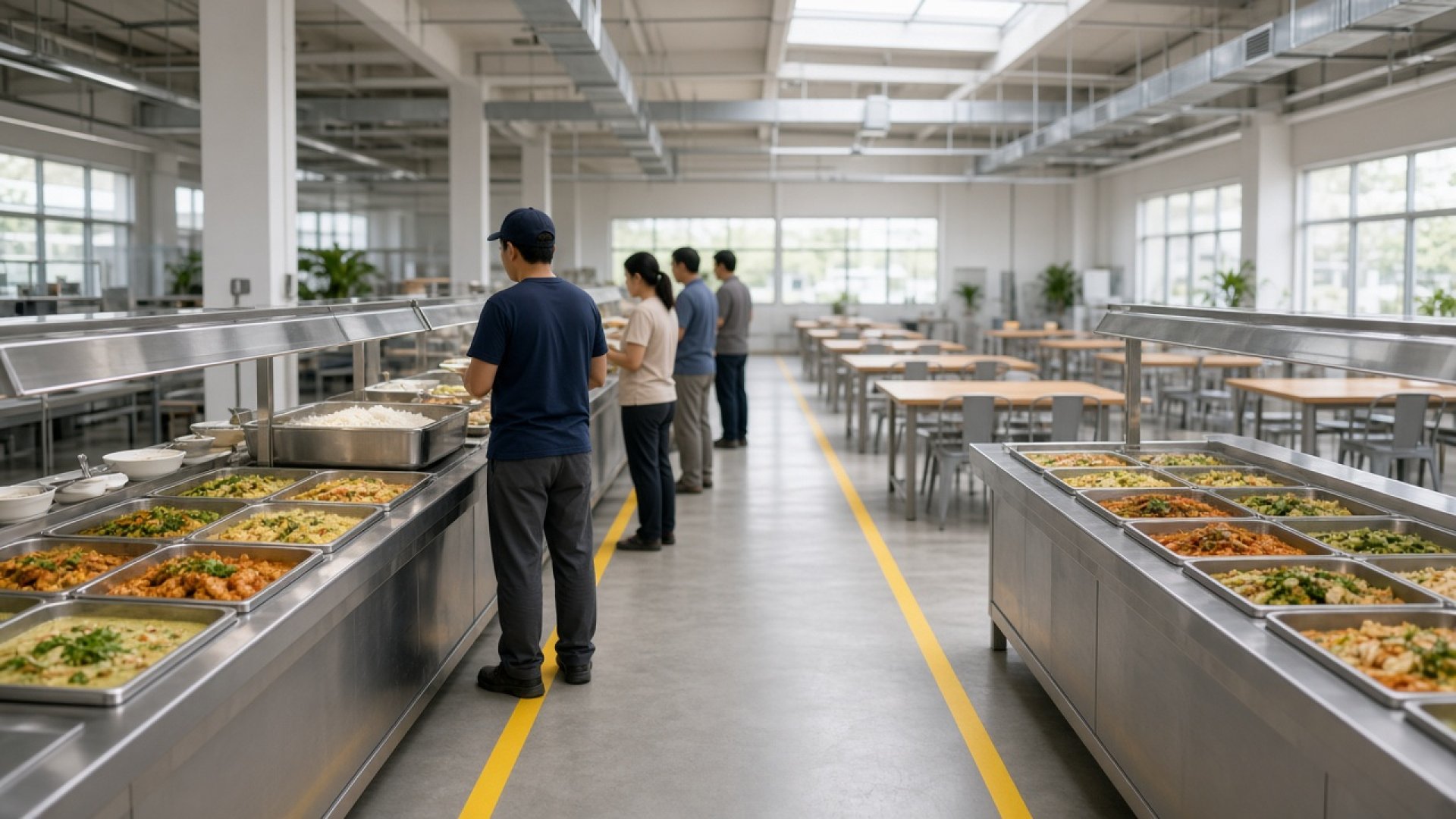
A good line flows in one direction, never doubles back and never makes people stop and wait in the middle. Getting the layout right often helps more than adding space. (general guidance)
Run multiple lines with the same menu
If space allows, two lines serving the same dishes split the crowd straight away, because nobody has to choose a line for a particular dish. If you only have one line, try serving from both sides.
Use floor markings and clear signs
Lane markings on the floor show where the queue starts, where to walk and where to exit. Put the menu board before the serving counter so people decide while they wait, not while they stand in front of the trays.
Move water, cutlery and condiments out of the main line
Keep trays and plates at the start of the line, and move cutlery, drinking water and sauces to the end or to a separate table. The serving line then has one job: hand over food and keep people moving.
Do staggered lunch breaks really reduce crowding?
Yes. Staggering spreads arrivals so that not everyone reaches the canteen at the same moment. Even two or three break slots often clear both the queue and the seating area without enlarging the canteen. (general guidance)
- Start with real data: note when the canteen is busiest and how many people each department has.
- Split by department or production line: keep the slots similar in size and avoid disrupting production.
- Leave a gap between slots: give the kitchen time to refill and clear tables; move a team if one slot is still crowded.
- Communicate the schedule: post it in the canteen and send it to every supervisor.
For shift-based factories, align break slots with shift changes too. See our article on meal welfare for factory shift workers.
How do pre-portioned meals and grab-and-go lunch boxes cut queues?
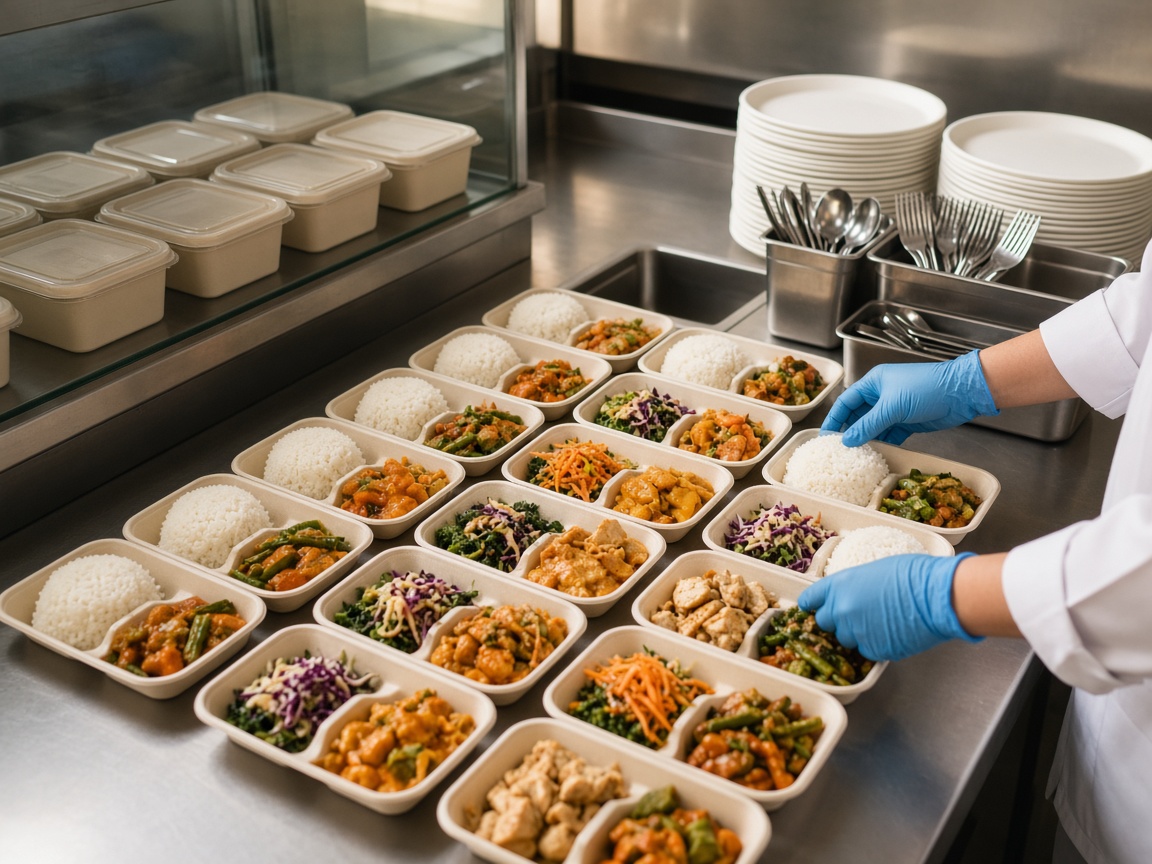
They remove plate-by-plate serving from the busiest minutes. When part of the food is already portioned, people pick it up and move on, so the line gets shorter. (general guidance)
Pre-portion part of the menu
Before the break starts, the kitchen can portion a share of rice and dishes based on recent daily numbers. This also keeps portions consistent and reduces leftovers, as covered in our guide to food waste management for factory canteens. Food must be held at safe temperatures.
Add a grab-and-go lunch box corner
A lunch box corner suits employees with short breaks or those who prefer to eat elsewhere. Place it near the entrance, away from the main line, with clear menu signs, so these employees do not join the same queue.
Choose dishes that serve fast
At peak time, offer main dishes that can be served in one scoop, such as curry over rice or set plates. Cook-to-order items such as noodle soup should have their own station so they never stop the main line. For more ideas, read our guide to factory staff menu planning.
How much do payment and coupons affect the queue?
A lot, because the payment point is the other place where people have to stop. If meals are a company benefit, employee cards or coupons that can be checked quickly help. If employees pay for themselves, add a payment point or consider QR and other cashless payment. (general guidance)
- Put the payment point after the serving line, with enough room for people carrying trays.
- Use one coupon or card format across the whole canteen to avoid confusion.
To find out which payment options TJ FAVOR GROUP can work with, ask the team directly.
Not enough seats: how do you turn tables over faster?
Help people find a seat quickly and leave easily. Seating problems are usually solved with table layout and tray return points, not by asking employees to eat faster. (general guidance)
- Keep the main walkway clear and offer both group tables and single seats.
- Place tray return and food scrap points near the exit, so people leaving do not cross those arriving.
- Have staff wipe tables continuously during the peak instead of waiting for the slot to end.
How should canteen staff be deployed at peak time?
Put people where the queue usually gets stuck, with someone ready to help when the line grows. Each team member should know in advance which station they cover: serving, refilling, payment or clearing tables. (general guidance)
- Refill trays before they run empty so the line never stops.
- Agree on a simple signal for when a station needs help.
How do you measure canteen waiting time?
Time how long it takes from joining the queue to receiving food, on different days and break slots, before and after each change. This gives HR and the provider the same facts to discuss instead of impressions. (general guidance)
- Take sample timings at the start, middle and end of each break slot.
- Count how many people are still queuing at the busiest moment.
- Ask employees as well; see sample questions in our employee canteen satisfaction survey guide.
What should you ask a canteen provider about queue management?
Ask to see how they actually run the peak, not just the menu. These questions work when selecting a new provider and when reviewing your current one. (general guidance)
- How many serving lines will you run, and what layout suits our space?
- Will you pre-portion meals or offer grab-and-go lunch boxes?
- Which payment or coupon methods can you work with?
- How will you measure waiting time and report it to us?
Add these points to your tender documents (see our canteen outsourcing RFP guide for HR and procurement). For company events, see buffet line setup for company events.
How does TJ FAVOR GROUP support workplace canteens?
From the company website:
- Based in Bangkok, with a team that has over seven years of restaurant experience.
- Canteen management for factories, offices and schools, so organisations can focus on their core business.
- For event catering, tableware and cutlery are provided, there is no extra service charge, and bookings need only two days' notice.
For serving line set-up, lunch boxes or payment options, ask the team about your own space and headcount.
Frequently asked questions about reducing canteen lunch queues
Our canteen queue is long. What should we fix first?
Find out whether the queue gets stuck at the serving line, the payment point or the seating area, and fix that first. Sometimes simply moving cutlery and water out of the main line speeds things up.
How many lunch break slots should we have?
It depends on headcount and canteen size. Many organisations start with two or three slots by department, then adjust based on measured waiting times.
When does a grab-and-go lunch box corner make sense?
It suits canteens with a short, crowded peak, or employees whose breaks do not match everyone else's. Keep quantities close to actual daily demand.
Do we need a cashless payment system?
Not always. If meals are a company benefit, quick-to-check employee cards or coupons can be enough. If employees pay themselves, QR payment or an extra payment point usually helps a lot.
How do we know the queue is really shorter?
Time the wait from joining the queue to receiving food on several days and break slots, before and after the change, and compare the results.
Talk to TJ FAVOR GROUP about your staff canteen
If you want to reduce canteen lunch queues at your site, send us your headcount, break schedule and canteen size. Our team will be glad to advise and prepare a quote that fits your organisation.
- LINE: @tjfavor (with the @)
- Phone: 063-878-8169 / 087-746-0044 / 096-949-6622
- Email: tjfavorgroup@gmail.com
- Website: tjfavor.com
See our canteen management service, our English home page or contact the team.