Canteen Kitchen Equipment: How to Choose and Supply It, a Guide for HR, Procurement and Facility Teams
Key takeaways
- Canteen kitchen equipment should be chosen from the real workload: people per shift, service window, menu, and the time when most dishes come back.
- Before ordering, have a technician check power, water, gas, drainage and ventilation, so building work does not have to be redone after the equipment arrives.
- Write down who owns, installs, repairs and replaces the equipment, as between the organisation and the canteen provider.
A fridge that is too small means deliveries several times a day. A dishwasher that cannot keep up with the lunch break, or a stove that cannot be connected because the building is not ready, is a problem that many facility and procurement teams meet only after the order is placed. Planning canteen kitchen equipment should therefore start from the real workload, the building systems, and an agreement on who supplies and looks after what. This guide is for business owners, HR, procurement and facility teams. It is general guidance, not legal or engineering advice; follow the manufacturer's manual, the chemical safety data sheet (SDS) and local rules first.
What equipment does a canteen kitchen need, and how is it grouped?
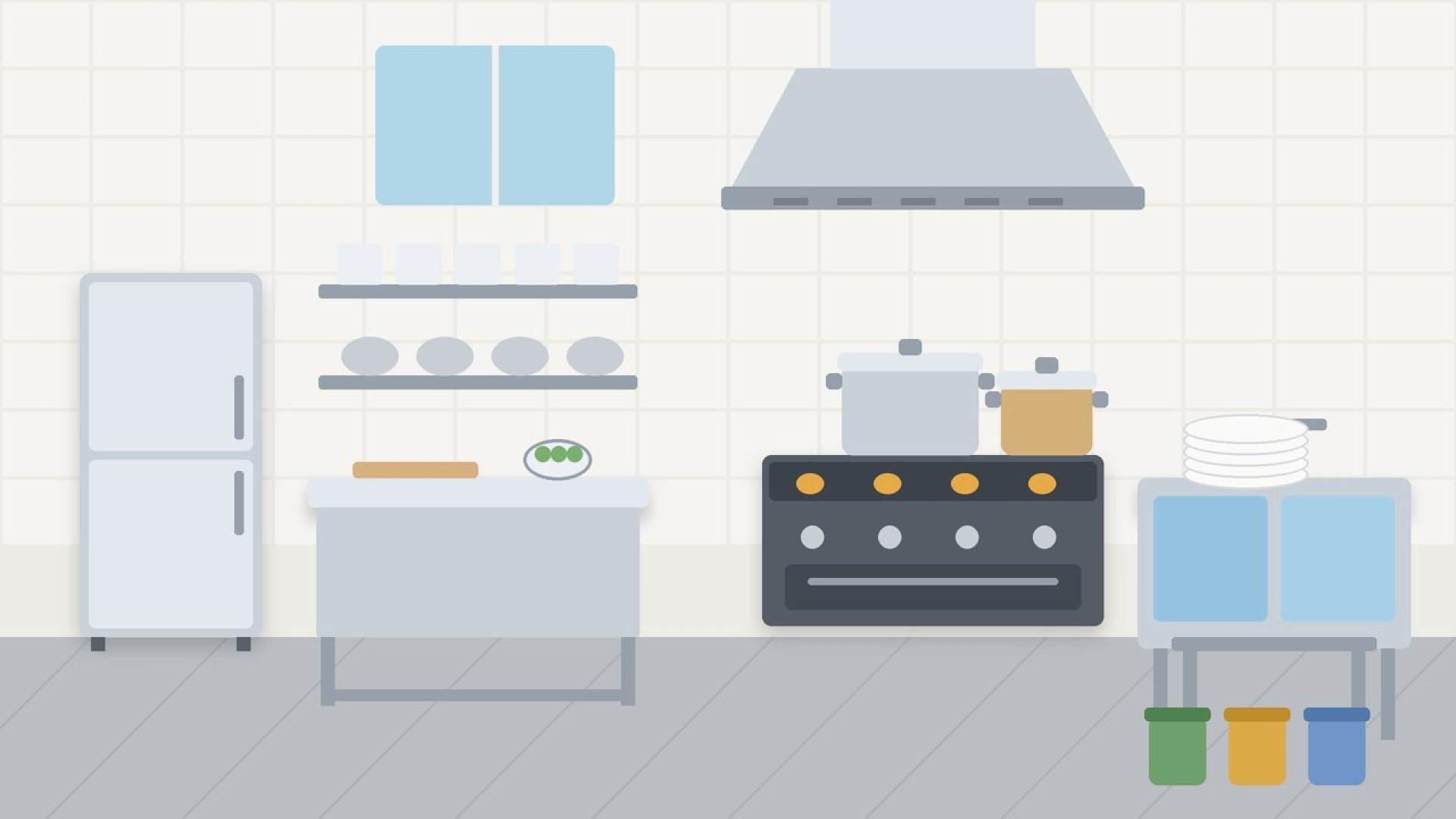
Canteen kitchen equipment can be grouped by the order of the work into six groups: receiving and storing ingredients, preparation, cooking, holding and serving, washing and storing dishes, and waste and hygiene. A kitchen does not need every item, as it depends on the menu and service style.
| Work group | Example equipment | Points to think about |
|---|---|---|
| Receiving and storage | Refrigerators, freezers, cold rooms, stainless shelves, scales, trolleys | The amount stored and how often suppliers deliver |
| Preparation | Prep tables, ingredient sinks, chopping boards, cutters or grinders | Keep raw and cooked food apart |
| Cooking | Stoves, large pots, steamers, ovens, extraction hoods | Capacity and time per batch, and the gas or power supply |
| Holding and serving | Food warmers, heated counters, serving pans, serving trolleys | Number of serving points and refilling |
| Washing and storing dishes | Sinks, dishwashers, drying racks, closed storage cabinets | The period when dishes return at the same time |
| Waste and hygiene | Sorted waste bins, hand-wash sinks, grease traps | Positions that do not block walkways |
For how these zones and walkways are arranged, see canteen design: a guide to layout and seating.
Who should supply canteen kitchen equipment, the organisation or the provider?
There are several models: the organisation owns it, the provider brings its own, it is rented from a supplier, or a mix. What matters is not the model but writing down who owns it, who repairs it and who replaces it when it stops working.
| Model | Suits | State clearly |
|---|---|---|
| Organisation owns it | Long-term control of assets | Who services it and who pays for repairs |
| Provider brings its own | No wish to invest in equipment | The equipment list and the owner at contract end |
| Rented from a supplier | Flexibility | Repair service, spare units and return terms |
| A mix | Kitchens with some existing items | A list of existing items and their condition |
Buying suits main equipment used for a long time that the organisation wants to own, while renting lowers the starting investment and often includes repairs, but the contract terms must be read in full. If you are considering a change of provider, list the existing equipment and its condition first, as in the checklist for switching canteen providers. For occasional events, renting tableware and equipment is a different matter from a permanent canteen kitchen; see catering equipment rental: a checklist before asking for a quote.
What should the size and number of canteen kitchen equipment be based on?
Start by asking how many people must be served in the short window of each shift, then work back to when each step must be finished. Catalogue capacity should be compared with the real menu and the time per batch, not read as a number alone.
- People and service window: total headcount is not the same as the people who collect at once, so look at each shift's break.
- Menu and batch cycle: boiled and stir-fried dishes use different equipment, so check how many portions each batch makes and how long it takes.
- When dishes come back: the wash point must cope with dishes returning together; if it cannot, clean dishes run short and the queue grows.
- Storage space: if suppliers deliver less often, more cold storage is needed.
If the lunch queue is long, read reducing canteen queues at lunch before deciding to buy more equipment.
What power, water, gas and ventilation checks come before ordering kitchen equipment?
Have a qualified technician or contractor check the site before ordering, because fixing building systems after the equipment arrives often takes more time and cost than expected.
| System | Questions to ask | Who should check |
|---|---|---|
| Electricity | Can the building supply cope with the machine's load, and are breakers and earthing complete? | A qualified electrician |
| Water and drainage | Is pressure and hot water enough, and is the drain in the right place? | A plumber or contractor |
| Gas | Which gas is used, and are leaks checked on a schedule? | A qualified gas installer |
| Ventilation | Does the hood suit the stoves installed, and do smells reach other areas? | A ventilation contractor |
| Access and working space | Are doors and aisles wide enough, and is there room to remove parts for cleaning and for a technician? | Facility team and supplier |
Also decide who is responsible for building services and alteration work.
How should dish-washing equipment and the wash zone be planned?
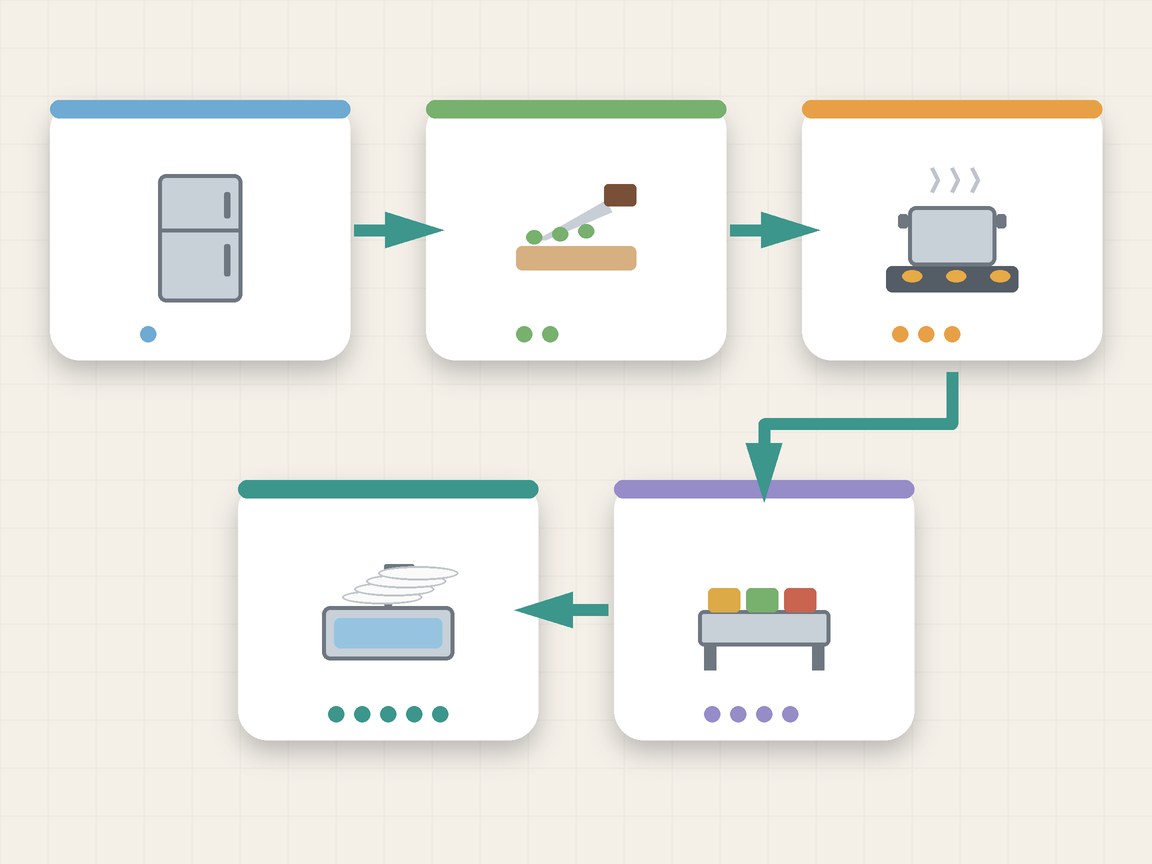
The wash zone should run as one path from dirty to clean: receive trays, scrape, pre-rinse, wash with detergent, rinse, sanitise as the machine manual says, dry, and store in a closed place, with clean dishes never crossing paths with dirty ones.
- Receive trays: a rack or trolley that does not block diners' walkways.
- Scrape food waste: into a separate bin before washing, to reduce load on drains and the grease trap.
- Wash and rinse: use a machine or sinks sized to the number of dishes, and use chemicals as the label and the SDS say, never mixing different products.
- Sanitise and dry: follow the machine manual or the canteen's own routine, then dry on a ventilated rack.
- Store dishes: in a closed cabinet or rack, away from the floor and from splashes.
Have enough people at the wash point on each shift, keep chemicals apart from food with clear labels, and use the protective gear the SDS recommends. For a daily kitchen check built on the same idea, see the daily food safety checklist for canteens.
What should you look at for materials and cleaning of kitchen equipment?
Choose equipment whose food-contact surfaces are food-grade stainless steel or another material suited to food work, smooth and easy to take apart, then set cleaning rounds from the manufacturer's manual with an owner for each task.
| Round | Example tasks | Owner to name |
|---|---|---|
| After each use | Wipe tables and machines, wash food-contact parts, empty scraps into the separate bin | Kitchen staff at that station |
| Daily after service | Wash floors and drain channels, wash sinks, wipe fridge exteriors, check fridge door seals | The closing team |
| Weekly | Wash hood filters as the manual says, wash shelves, check pipes and taps for leaks | Head cook or facility team |
| On the technician's or contractor's round | Look after the grease trap, hood ducts, refrigeration and the dishwasher | The assigned technician or contractor |
Keep a short log sheet on site for people to sign, and when a machine has a problem, call the technician rather than taking parts off beyond what the manual allows. Water and energy savings are simple: cover pots while boiling, load the dishwasher fully but not over capacity, and check taps and pipes for leaks regularly.
What should you ask a supplier or canteen provider about kitchen equipment?
Ask for the quote to be split into equipment, delivery, installation, training and after-sales service, with a document of each machine's system requirements, so that offers can be compared on the same basis.
- Item, model, quantity and usable capacity, stating whether the figure refers to raw ingredients or cooked food.
- Power, water, gas and space requirements, in writing.
- Who installs, test-runs and trains the kitchen staff.
- Delivery time, and repair service, spare parts and spare units under the maker's or supplier's terms.
Procurement can put these topics into a request for proposals, following the approach in the guide to outsourcing canteen management for HR and procurement, and find more questions in how to choose a canteen caterer. A common mistake is to pick the machine from catalogue capacity first and only then check whether the building and the people can support it; do it the other way round.
Frequently asked questions about canteen kitchen equipment
What should canteen kitchen equipment be chosen from?
Start from the real workload: how many people collect at once, the menu and the time per batch. Then check the building systems and space, and only then choose the model and number.
Should the organisation or the canteen provider supply the kitchen equipment?
Either can work, depending on investment and the contract. What must be written down is who owns, installs, repairs and replaces the equipment, and the terms when the contract ends.
Does a canteen need a dishwasher?
It depends on how many dishes return at the same time and how many people work at the wash point. Have the supplier and the facility team assess it together, and check water, power and drainage before deciding.
How often should kitchen equipment be cleaned and serviced?
Follow each manufacturer's manual, split into tasks after each use, daily, weekly and on the technician's round, and record each one.
Does TJ FAVOR GROUP supply or install canteen kitchen equipment for organisations?
Our website describes canteen management and catering services, which include preparing tableware and equipment for events, but it does not list supplying, selling or installing canteen kitchen equipment as a main service. This article is therefore general guidance. If you are interested in the equipment scope of a canteen, please contact our team to discuss it.
Talk to TJ FAVOR GROUP about canteen management and kitchen equipment
TJ FAVOR GROUP is a canteen management and catering company based in Bangkok, with more than seven years of restaurant experience. Our team is ready to listen to the needs of your canteen and kitchen and offer an initial consultation, and our hotline is open around the clock.
- LINE: @tjfavor (including the @)
- Phone: 063-878-8169 / 087-746-0044 / 096-949-6622
- Website: tjfavor.com
See more on the canteen management page, the catering page, about us, or contact the team.