Office Pantry Snacks Running Out Yet Still Going to Waste? How to Control Stock and Budget
Key takeaways
- When office pantry snacks both run out and go to waste, the cause is usually ordering by habit rather than by actual usage.
- Group items by how fast they move, then set a par level and reorder point for each one.
- Count once a week with the same sheet and follow FEFO so whatever expires first is used first.
- Track spend per head per month and agree who approves new items.
Office pantry snacks and drinks, such as coffee, tea, milk, water and small snacks, are a small welfare benefit employees use every day. Yet many organisations meet the same problems again and again: some items run out before the next order, others sit until they expire, and nobody is sure where this months budget went. This is general guidance for HR, procurement and facility teams on building a stock list, setting stock levels, counting, handling expiry dates and tracking budget, so there is enough to go round without waste.
Why do office pantry snacks run out and go to waste at the same time?
Because orders are usually placed as one block by habit, without separating fast movers from slow movers. Popular items disappear quickly, while items few people pick sit until they expire.
Another cause is the lack of a clear owner: whoever sees an empty shelf buys more, so no usage history is kept. If your organisation has not yet defined the roles of HR, procurement and facilities in pantry work, start with office pantry management for HR and procurement. This article goes deeper into stock, waste and budget only.
How should you build a snack and drink list based on usage?
Start from what employees actually use, then group items by how fast they move rather than by product type. This shows which items need frequent checks and which should be ordered less.
| Group | Examples | How to think about it |
|---|---|---|
| Daily essentials | Water, coffee, tea, sugar, creamer, cups | Must not run out; set the reorder point with enough buffer to cover delivery time |
| Fast-moving snacks | Crackers, nuts, dried fruit in small packs | Restock to par and note which flavours go first |
| Slow movers | Niche flavours, imported items, large bags | Order less, or move them to meeting use |
| Short-life chilled items | Milk, yoghurt, fresh fruit | Order more often in smaller amounts; check expiry at every restock |
| Trial items | New items employees ask for | Trial for a short cycle before adding to the regular list |
For what a pantry should stock in the first place, see the office pantry service guide. If you run a staffed coffee corner, see workplace cafe and coffee corner management.
How can you set simple par levels and reorder points?
A par level is the amount that should be on the shelf after restocking. A reorder point is the level at which you must order straight away. Both should come from the actual usage of each item.
- Par level: base it on usage over one order cycle plus a small buffer. Do not set it so high that shelves overflow, because items at the back get forgotten.
- Reorder point: base it on usage between ordering and delivery, plus a buffer for days with meetings or events.
- Write both values on the shelf label or count sheet so whoever restocks can see them without remembering.
- Review them monthly. If an item often runs out early, raise its reorder point; if stock sits close to expiry, lower its par level.
The same idea works for factory welfare stores; see stocking a factory welfare store by shift.
How do you run a weekly stock count that is fast and reliable?
Count on the same day and time each week, list items on the sheet in shelf order, and record stock on hand, deliveries received and waste so actual usage can be calculated.
- Pick a quiet time, such as the first morning of the week.
- Use the same unit every time, for example packs or boxes, without switching.
- Keep a separate column for damaged, expired or opened-and-abandoned items.
- Actual usage equals last weeks stock plus deliveries, minus this weeks stock, minus waste.

How do FIFO and FEFO apply to pantry expiry dates?
FIFO means first in, first out; FEFO means first expired, first out. For pantry food, make FEFO the main rule, because the expiry date is what forces items into the bin.
- When restocking, bring older stock to the front and place new stock behind or below it.
- If you decant a large box into containers, label each container with the expiry date and the date opened.
- Set up a take first basket for items close to expiry and tell employees about it.
- Check the pantry fridge at least weekly and agree clearly who removes expired items, the pantry owner or the cleaning team; see the handover example in the office cleaning scope of work for pantry and canteen zones.
Which pack sizes and portions help avoid waste?
Choose sizes that are used up before the item spoils. Items that keep only briefly once opened, such as large cartons of milk or big snack bags, are a common cause of waste.
- Small individual packs control the amount per serving and reduce half-open bags.
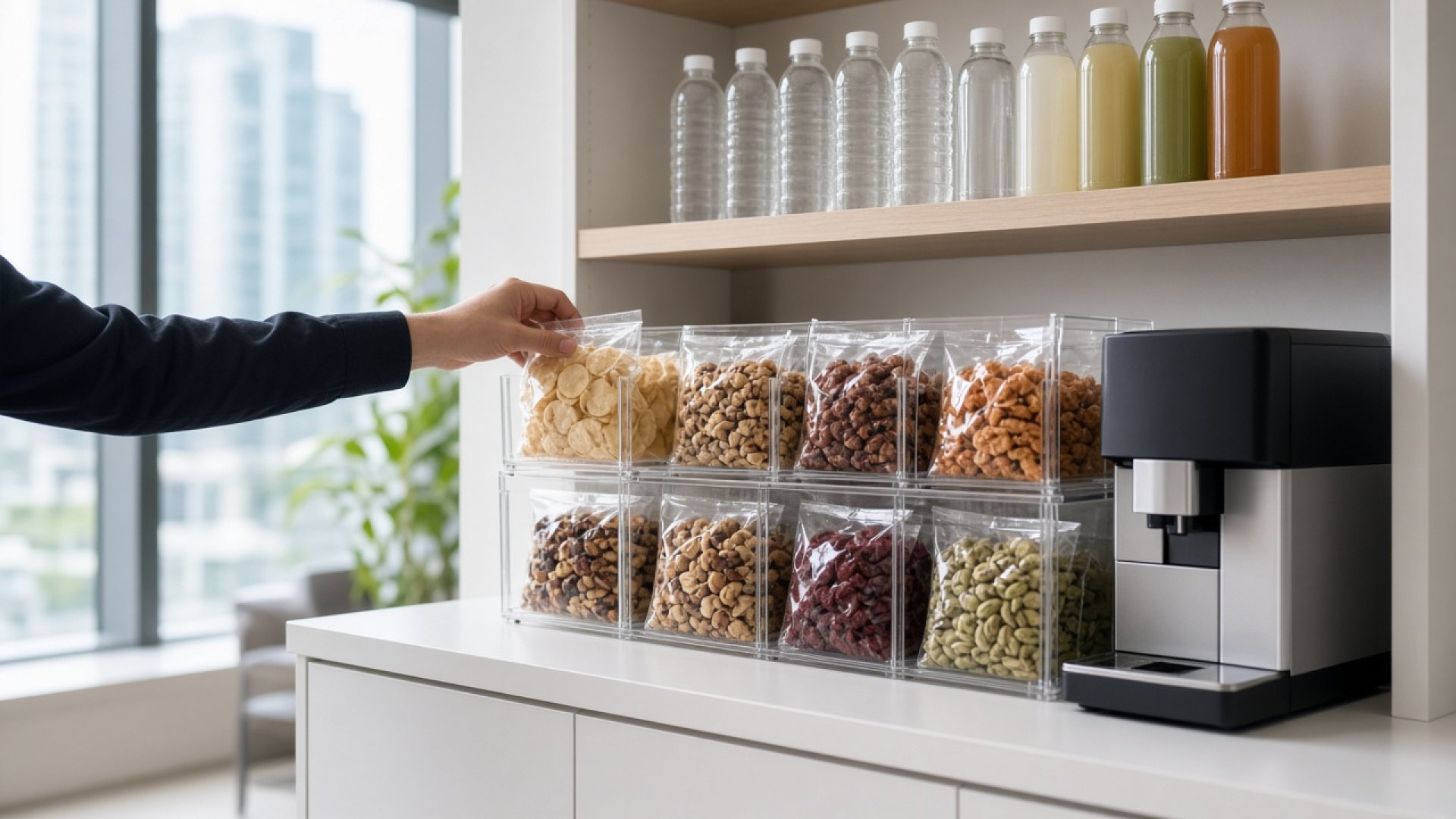
- Decant bulk boxes into clear lidded containers that show the level and carry an expiry label.
- For milk or creamer, pick sizes that are finished within a day or two, based on real user numbers.
- Compare unit cost together with the amount thrown away, not just whether the big box looks cheaper.
If you also run a canteen, the same thinking applies to food scraps; see factory canteen food-waste management.
How should you track spend per head and set approvals?
Add up the months pantry purchases, divide by the number of employees using the pantry, and follow the per-head figure as a monthly trend rather than looking only at the total, because headcount changes all the time.
- Split spending into groups such as core drinks, snacks and consumables, so you can see where increases come from.
- Keep meeting snacks, parties and special events out of the regular pantry budget.
- Record the value of waste each month as a sign that par levels or pack sizes need adjusting.
- Agree who approves new items, brand changes and off-cycle orders, while routine restocking to the existing par level can go ahead without extra sign-off.
What should you ask a supplier or pantry operator?
Good questions show how the operator counts, restocks and reports, not just how long its product list is.
- How do you set par levels and reorder points, and when do you adjust them?
- What are the delivery cycle and lead time, and what do you substitute if an item is out?
- Do you report usage, stock on hand and waste each month?
- How do you handle items near expiry, and can they be exchanged or returned?
- Does the proposal show product cost, delivery and restocking service separately?
For the bigger picture of where pantry work sits among building services, see what soft services are, including the canteen and pantry side of facility management.
Checklist for controlling pantry snacks and drinks
| Task | Example frequency | Example owner |
|---|---|---|
| Check whether essentials have reached the reorder point | Daily | Pantry owner |
| Restock to par following FEFO | Each restock round | Pantry owner |
| Count stock and record waste | Weekly | Pantry owner |
| Check the fridge and the take-first basket | Weekly | Pantry owner or cleaning team, as agreed |
| Summarise spend per head and waste value | Monthly | Procurement |
| Review the list, par levels and employee feedback | Quarterly | HR with procurement |
Frequently asked questions
How often should office pantry stock be counted?
For most offices, a weekly count on the same day and time is enough. Fast movers such as drinking water or milk can be checked by eye daily to see whether they have reached the reorder point. Use the same count sheet every time so actual usage can be compared.
How should we set a pantry budget per head?
Record purchases and actual usage for a while, then divide by the number of employees using the pantry that month to get your own reference figure. Review it monthly and keep meeting snacks separate.
What is the difference between FIFO and FEFO, and which should we use?
FIFO means first in, first out; FEFO means first expired, first out. For pantry food FEFO usually fits better, because a newer batch can sometimes expire sooner than an older one.
What should we do with items close to their expiry date?
Move them to a labelled take first basket or shelf and let employees know. If the same item keeps ending up there, lower its par level or switch pack size. Items past their expiry date should be removed and recorded as waste, not handed out.
Does TJ FAVOR GROUP supply office pantry snacks and drinks?
The website lists canteen management, staff meals and event catering as its main services. It does not list pantry supply or restocking as a service. If your organisation wants to discuss pantry stock controls alongside staff meals, the team is ready to give initial advice.
Contact the team
TJ FAVOR GROUP is a Bangkok-based company with more than seven years of experience, running canteen management, monthly staff meals and event catering, with a twenty-four-hour hotline. The website does not list pantry supply or restocking as a service. If your organisation wants to talk about food welfare and pantry stock controls alongside staff meals, the team is ready to give initial advice. See the canteen management service page, read about us or contact the team.
Phone 063-878-8169 / 087-746-0044 / 096-949-6622
LINE @tjfavor