Should Soft Services and the Canteen Sit with a Single Vendor? Pros, Risks and a Transition Checklist
Key takeaways
- Placing soft services and canteen management with a single vendor reduces handoff gaps between teams, but it also increases dependence on one company.
- Before deciding, map which team looks after which zone, at what time, and where work passes from one team to another.
- One master contract can work well, but keep a separate SLA for each service, a backup team and terms for splitting a service out later.
- A phased transition, one service at a time, is usually easier to control than switching everything on the same day.
More organisations are asking whether a single vendor for soft services and canteen work makes sense: one company for cleaning, housekeeping, the pantry, general waste collection and canteen management, instead of several separate contracts. The usual reasons are tiring back-and-forth coordination and problems that fall between teams. This guide covers the pros, the risks, contract models, how to write the SLA, questions to ask and a transition checklist for HR, procurement and facility teams. It is general planning guidance, not legal advice and not procurement advice under any organisation's purchasing rules.
What does a single vendor for soft services and the canteen mean?
It means one main vendor is responsible for the non-technical services on a site, such as cleaning, housekeeping, the pantry and the canteen, under one master contract and one main coordinator. The vendor may deliver every service with its own teams or subcontract some of them.
The same idea is called single vendor, master vendor or integrated facility management (IFM). If you are not yet sure what soft services cover, start with the overview what soft services are, including the canteen and pantry side of facility management. This article picks up from there and answers the decision question: should you combine or keep services separate?
Why are organisations combining soft services with canteen management?
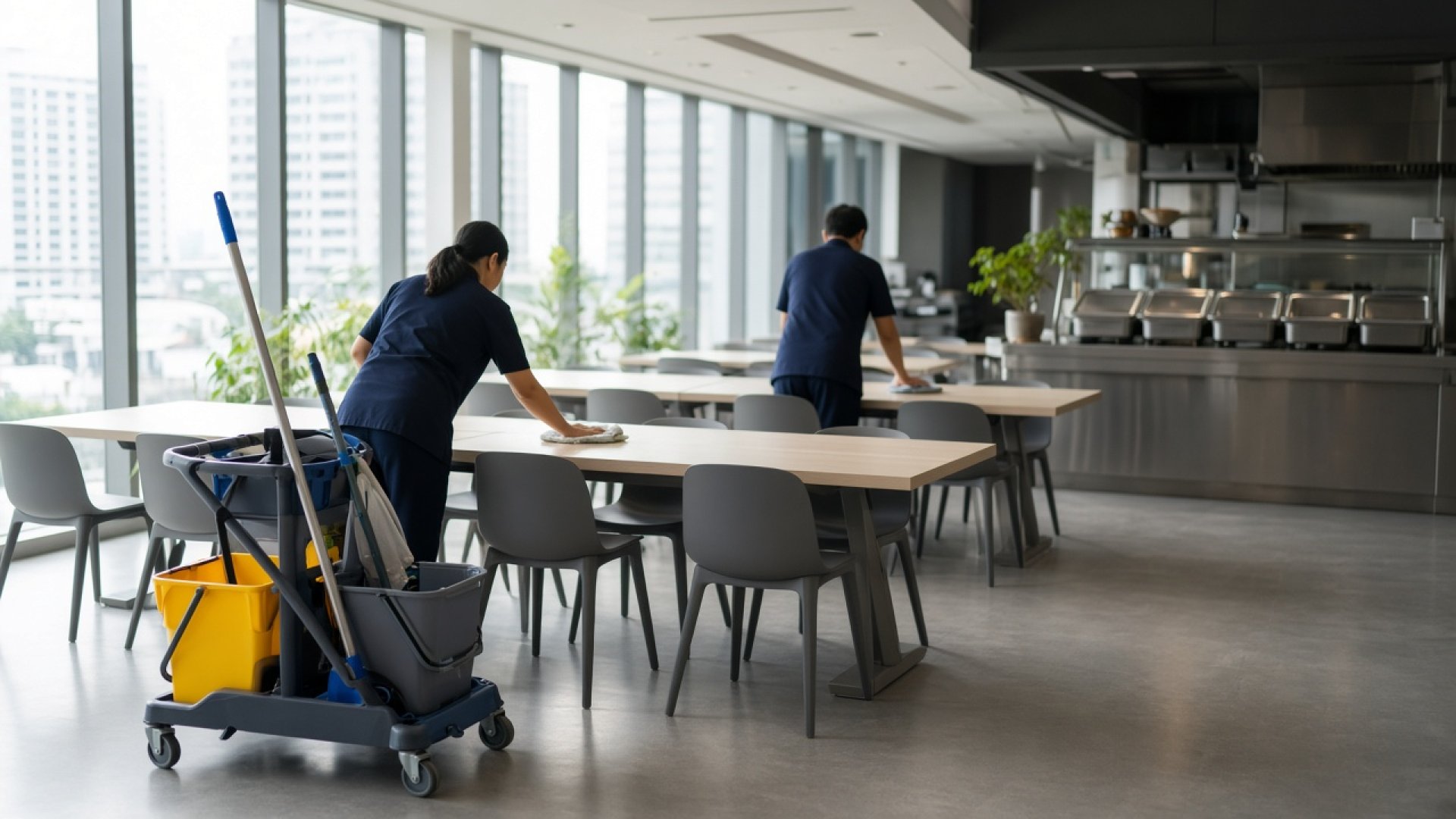
The main reason is the handoff between services. The canteen is where several kinds of work meet: food, cleaning of shared areas, food scraps and pest control. When each task belongs to a different company, small problems often have no owner.
- The floor in front of the food line is wet after the lunch break. The kitchen team says it is a housekeeping job; housekeeping says it is not their round yet.
- Food-scrap bins fill up before collection because the waste round does not match the serving times of each shift.
- An office-floor pantry runs out of supplies, but it is unclear whether that belongs to the pantry provider or the floor housekeeper.
Having one main owner does not make problems disappear. It does make it clear whom to call and who must close the issue.
What are the pros and risks of a single vendor?
The advantages are simpler coordination and one set of reports. The risks are heavy dependence on one company and thinner specialist skill in some services. Weigh both sides against the reality of your own site.
| Point | Single vendor | Several separate vendors |
|---|---|---|
| Coordination | One main coordinator receives and closes issues | The facility team coordinates between teams itself |
| Handoffs between services | Easier to plan shared rounds | Handoff points must be written into every contract |
| Specialist skill | Check that each service has a genuinely skilled team | Easier to pick a specialist per service |
| Dependence | A problem at the vendor affects many services at once | Risk is spread more widely |
| Documents and reports | One invoice and one report set | Several formats to combine |
| Changing vendor | Harder, because many services are tied together | Easier to replace one vendor at a time |
Sites with several buildings, several shifts and a large canteen often gain the most from fewer handoffs. Organisations already happy with some existing vendors may combine only part of the work.
Which contract models are common?
Three models are common: separate contracts per service, a master vendor with subcontractors, and an integrated vendor that delivers every service itself.
- Separate contracts per service: each service has its own contract and the organisation coordinates them. This fits when the facility team has time to follow up closely.
- Master vendor with subcontractors: one master contract, with the main vendor hiring specialists for some tasks. Ask for the subcontractor list and the right to approve changes.
- Integrated vendor: the vendor uses its own teams and systems for everything. A single way of working is easier to keep, but you must check readiness for each service carefully.
A hybrid also works: for example, the canteen operator takes on the pantry while building cleaning stays with the current contractor.
How should you write the SLA when services are combined?
Use one master contract but a separate SLA for each service, so good results in one service do not hide problems in another. Add a zone map that shows who is responsible for which area at what time.
| Service | What the SLA should state | Handoffs that are often missed |
|---|---|---|
| Canteen management | Serving rounds by shift, kitchen cleanliness, ingredient receiving and feedback | Who wipes tables and seating between serving rounds |
| Shared-area cleaning | Cleaning rounds, acceptance criteria and urgent-response handling | The floor in front of the food line and the tray-return point |
| Pantry | Restock rounds, expiry checks and equipment care | Who washes cups and changes pantry bin bags |
| General waste and food scraps | Collection rounds, holding points and sorting | The handover to the waste collector the organisation already uses |
| Pest control | Inspection rounds and reporting of risk spots | Alerts from kitchen and housekeeping staff when signs appear |
Every service should use the same issue-reporting channel, agreed response times and reports that can be read together. For canteen scope, see the canteen outsourcing guide for HR and procurement. For kitchen deep cleaning, see canteen kitchen deep cleaning, and for food scraps, see factory canteen food-waste management.

What should HR, procurement and facility teams consider before deciding?
Start from the real problems on site, not from a wish to cut the number of contracts. If the main problem is handoffs between services, combining may help. If the problem is the quality of one service, replacing that one vendor may be the more direct fix.
- HR: the welfare goal, employee satisfaction and feedback channels; see the employee canteen satisfaction survey guide.
- Procurement: criteria for comparing bids, fees split by service, and terms for splitting a service out later.
- Facility team: the zone map, rounds by shift, handoff points and a backup team when staff are absent.
Questions to ask a main vendor before signing
Good questions show how the vendor really manages several services at once, not just how long its service list is.
- Which services do you deliver yourselves, which do you subcontract, and can we approve subcontractors?
- Who is the main coordinator, how much authority do they have, and who covers when they are away?
- How do you fit cleaning rounds around each shift's serving times?
- What does the combined report contain, and can results be split by service?
- If we later need to split a service out, is that possible and how would the handover work?
- Have you looked after sites with a canteen and several shifts? Can we see a sample work plan or report format?
For choosing the food side, see how to choose a canteen caterer.
Moving from several vendors to one: which checklist should you follow?
Switching one service at a time is usually easier to control than switching everything together, because you see real performance before widening the scope.
- Check the end dates and termination terms of every existing contract.
- Map current zones and rounds, together with a list of recurring problems.
- Choose the first service to combine, often one next to the canteen, such as seating-area cleaning and the tray-return point.
- Set a short handover period in which the old and new teams overlap.
- Hand over equipment lists, keys, access cards and urgent contacts.
- Tell employees what the new issue-reporting channel is.
- Follow results closely in the first weeks, then consider the next service.
For a detailed canteen-side switch, see the canteen provider transition checklist.
Should the pantry sit with the canteen operator or the housekeeping team?
It depends on what the pantry mainly needs. If the focus is supplying drinks and snacks, the team that runs food may give better continuity. If the focus is washing cups and wiping surfaces, the floor housekeeping team may be closer. Write down who restocks and who cleans. See office pantry management for HR and procurement and the office pantry service guide.
Frequently asked questions
Does a single vendor reduce costs?
Not always. Some organisations save coordination and paperwork time, but fees depend on the scope and the contract model. Compare bids against the same scope and ask for fees to be split by service.
If the main vendor uses subcontractors, who is responsible when something goes wrong?
The contract should state clearly that the main vendor answers to the organisation, including for subcontracted work. Ask for the list of subcontractors and the right to approve changes before work starts, and have your own legal team review the wording.
Should you consolidate every service at once or one at a time?
Moving one service at a time is usually easier to control, because you see real performance before widening the scope. Services next to the canteen, such as seating-area cleaning and the tray-return point, are often a clear place to start.
How are soft services different from integrated facility management?
Soft services are the service tasks that look after people and spaces, such as cleaning, housekeeping, pantry and food. Integrated facility management is a contracting model that places several services with one vendor, sometimes including building systems as well.
Does TJ FAVOR GROUP take on all soft services?
The website lists canteen management, staff meals and event catering as its main services. It does not list cleaning, housekeeping or other soft services as a main service. If your organisation is planning how the canteen should work alongside other service teams, the team is ready to give initial advice.
Contact the team
TJ FAVOR GROUP is a Bangkok-based company with more than seven years of restaurant experience and ten restaurant branches, running canteen management, staff meals and event catering, with a twenty-four-hour hotline. The website does not list cleaning or other soft services as a main service. If your organisation is planning how the canteen should work alongside other service teams, the team is ready to give initial advice. See the canteen management service page, read about us or contact the team.
Phone 063-878-8169 / 087-746-0044 / 096-949-6622
LINE @tjfavor