What Does an Office Housekeeper Actually Do? Daily, Weekly and Monthly Duties, and the Tasks Contracts Often Miss

Key takeaways
- Write office housekeeping duties by zone and frequency (daily, weekly, monthly), not as a single line saying general cleaning.
- Tasks often missed: fridge clear-outs, meeting room resets, consumable refills, waste round timing and after-hours events.
- Describe results that can be checked, then inspect with the same sheet every time.
- Before signing, ask about cover for leave, who supplies materials and how the housekeeper works with the pantry or canteen operator.
Office housekeeping duties are visible to everyone every day, yet many contracts describe them in a single line about cleaning the office. The result is the same questions again and again: who clears the fridge, who resets the meeting room after a session, and who tidies up after a Friday evening party? This general guide is for HR, procurement and building or facility managers. It covers what a resident office housekeeper does, how to split work by frequency, which tasks are usually forgotten and how to inspect the work fairly for both sides.
What does an office housekeeper do, and how is it different from periodic cleaning?
An office housekeeper is based on site during working hours and keeps shared areas in order throughout the day. Periodic cleaning crews, by contrast, come in for larger jobs on a schedule and then leave.
Because the housekeeper is always there, the role tends to grow: cleaning, refilling and small favours. If these are not separated in writing, two problems appear at once. The housekeeper takes on more than one person can manage and core tasks slip, and the organisation has no record of what was in scope to begin with. Occasional heavy work, such as floor scrubbing or carpet washing, usually suits a separate periodic contract.
How should daily, weekly and monthly tasks be split?
Split by zone first, then add frequency within each zone. Anything people notice after a single missed day is daily; anything that builds up slowly is weekly; hard-to-reach spots are monthly. The table is a starting point; adjust it to your office size and actual use.
| Zone | Daily | Weekly | Monthly |
|---|---|---|---|
| Pantry | Wipe counters and tables, wash shared cups, refill paper cups, sugar and tissues, empty bins | Clear the fridge on the announced day; wipe the outside of the microwave and coffee machine | Wipe inside cupboards; clean skirting and under the counter |
| Meeting rooms | Reset tables and chairs after meetings, wipe tables, collect cups, clean whiteboards | Wipe glass partitions and table equipment | Clean upholstered chairs and under tables |
| Washrooms | Clean on timed rounds, refill soap and paper, check for odours and wet floors | Scrub grout and wipe cubicle partitions | Clean vents and high spots |
| Reception | Wipe the reception counter, glass doors and waiting seats | Wipe plants and literature racks | Deep-clean entrance mats |
| Work areas | Empty bins, mop walkways, wipe shared touch points such as door handles and lift buttons | Vacuum under desks in agreed zones | Wipe window ledges, air vents and high shelves |
For a contractor-style scope focused on pantry and canteen zones, see office cleaning scope of work for pantry and canteen zones. This article focuses instead on the resident housekeeper and the tasks contracts tend to miss.
Which housekeeping tasks do organisations often forget to put in the contract?
Usually the ones that sit between teams or happen outside normal hours. Everyone assumes someone else does them, so nobody writes them down.
- Fridge clear-out and handover: the announcement day, the clear-out day, which items the housekeeper may discard straight away and which need a decision from the pantry manager.
- Meeting room reset: after every booking or only on request, who requests it and what layout to restore.
- Consumable refills: who buys, who holds stock, and whether the housekeeper only refills or also counts and asks for reorders.
- Waste round timing: match collection times to the building's waste pickup and keep pantry food waste in separate bins. More ideas in factory canteen food-waste management.
- After-hours work and internal events: who clears up after evening events, how much notice is needed and whether it counts as extra work.
- Serving drinks to guests: if you want help with this, write it as a separate task because it is not cleaning.
- Closing round: checking taps, switching off washroom and pantry lights, reporting damage spotted.
- Cover during leave: who sends a replacement, with how much notice, and whether they get the same task list.
How should the housekeeping scope be written into a TOR or contract?
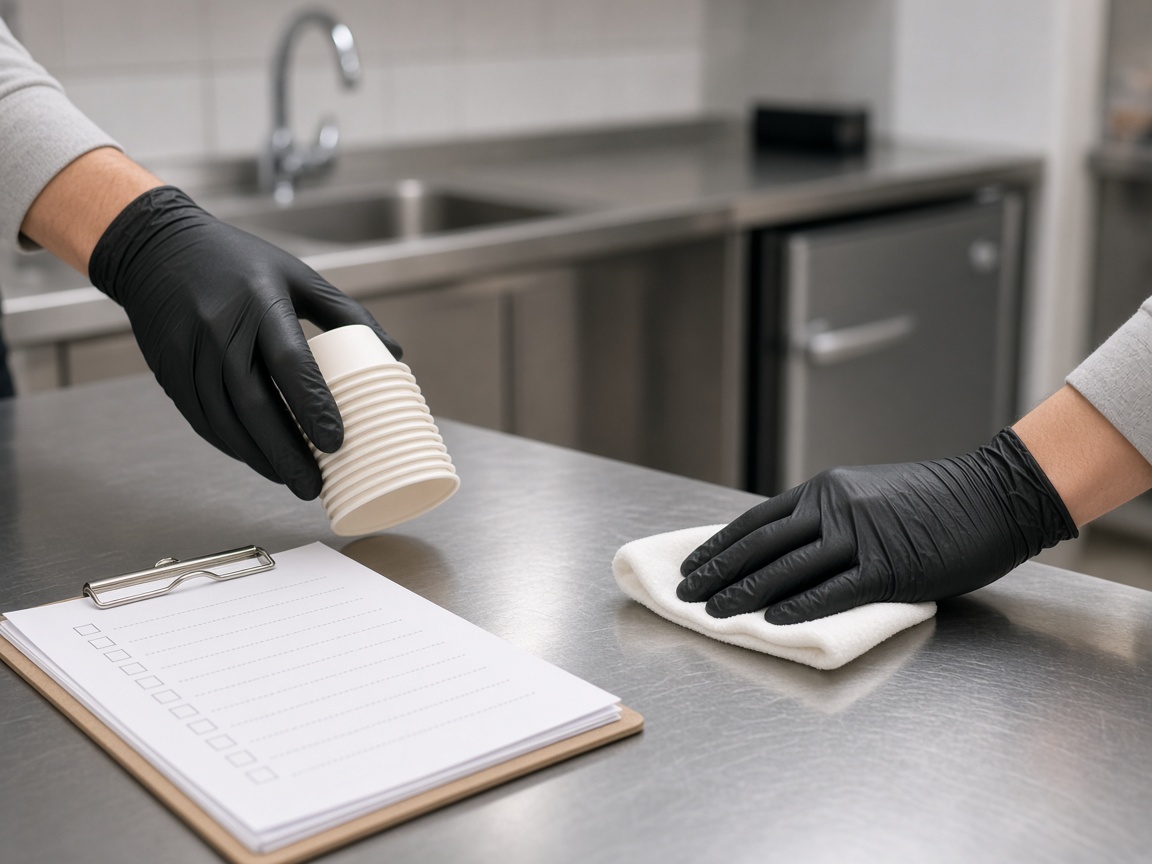
Use a table of zone, task, frequency, time window and a result that can be checked, instead of broad words such as clean and tidy. Attach the table as an annex to the contract.
- Checkable results: for example, no stains and no cups left on the pantry counter after the afternoon round, rather than pantry is clean.
- Time windows: state washroom and waste rounds as time windows, not just several times a day.
- Materials: who supplies chemicals, cloths, bin bags and washroom consumables, and who keeps the safety data sheets for chemicals.
- Out-of-scope requests: set one route, such as a single coordinator who logs requests, so the housekeeper does not take orders from everyone.
- Reporting: a daily check sheet, a weekly summary and a channel for urgent issues.
- Employment matters: working hours, rest days and overtime should be checked against current rules with the Department of Labour Protection and Welfare or your legal adviser. This article is not legal advice.
If you are bringing housekeeping, pantry and canteen into one picture, start with what soft services are, including the canteen and pantry side of facility management and the trade-offs in putting soft services and the canteen with a single vendor.
How can you inspect office housekeeping fairly?
Inspect against the same list that is in the contract, on the agreed schedule, and keep performance separate from requests that were never in scope.
- Do a short walk-through by zone at the same times, for example after the morning round and before close.
- Score weekly as pass or fail per item instead of by impression.
- Log complaints with the time raised and the time fixed.
- Photograph failed spots to discuss them, not to shame anyone in a group chat.
- Review monthly with the provider and adjust frequency where an area is used more or less than expected.
Questions to ask a housekeeping provider before signing
- Can you show a sample task schedule by zone and frequency?
- When the housekeeper is on leave, how is cover arranged and with how much notice?
- Who is the supervisor that inspects, and how often do they visit?
- Who supplies chemicals and equipment, and will you share a chemical list with safety data sheets?
- How do you train new housekeepers, especially for pantry tasks that involve food and drinks?
- How are out-of-scope or after-hours tasks requested and charged?
- How will the housekeeper coordinate with the pantry or canteen operator?
How do the office housekeeper and the pantry or canteen operator share the work?
A simple rule: the housekeeper looks after the cleanliness of the space and refills items on the list, while the pantry or canteen operator handles food, drinks, stock and expiry dates. The handover points to write down are fridge clear-outs, items near expiry and low-stock alerts. To define the pantry side clearly, read office pantry management for HR and procurement.
Frequently asked questions
What are the usual office housekeeping duties?
Typically cleaning work areas, washrooms, the pantry, meeting rooms and reception, collecting waste on set rounds and refilling consumables. Anything beyond that, such as serving drinks in meetings or helping after hours, should be written into the contract as a separate item.
How do weekly and monthly housekeeping tasks differ?
Weekly tasks do not need doing every day but show quickly if skipped, such as clearing the fridge or wiping glass partitions. Monthly tasks cover hard-to-reach spots such as air vents, window ledges and under furniture. Fix the days in advance so they can be checked.
Who should clear out the pantry fridge?
Agree it in the contract. For example, employees are told to remove their own items before a set day, then the housekeeper discards unlabelled or expired items and wipes the fridge. Shared snacks and drinks should be decided on by whoever manages the pantry first.
How often should office housekeeping be inspected?
Early in the contract, a short daily walk-through helps. Once things settle, move to a weekly score and a monthly review. Use the same inspection sheet every time and log complaints with the time they were raised and fixed.
Does TJ FAVOR GROUP provide office housekeepers?
The website lists canteen management, staff meals and event catering as its main services. It does not list office housekeeping or cleaning as a service. If your organisation wants to discuss how housekeeping fits with canteen or pantry work, the team is ready to give initial advice.
Contact the team
TJ FAVOR GROUP is a Bangkok-based company with more than seven years of experience, running canteen management, monthly staff meals and event catering, with a twenty-four-hour hotline. The website does not list office housekeeping or cleaning as a service. If your organisation wants to talk about how housekeeping fits with canteen, pantry and staff-meal work, the team is ready to give initial advice. See the canteen management service page, read about us or contact the team.
Phone 063-878-8169 / 087-746-0044 / 096-949-6622
LINE @tjfavor