Factory Vending Machine Guide: Location, Restocking, Payments and Contract Questions for HR and Procurement
Key takeaways
- A factory vending machine is an unattended unit that sells drinks, snacks or ready-to-eat food, so employees can buy during a short break without a dedicated shop assistant.
- Points to think through include the location, power and space, products by shift, restocking, cleaning, payment, and the agreement with a provider.
- HR and procurement should agree in advance who installs, who restocks, who repairs a fault, and who is responsible when goods expire or cash does not match.
Breaks in a factory are short, and on some shifts there is no shop open nearby. That is why a factory vending machine is often considered as a way to add to staff welfare. This guide is general guidance for HR, procurement and facility managers. It does not describe the services of any company and it is not legal advice. Electrical, safety and licensing matters should be checked with suitably qualified people before you decide.
What is a factory vending machine, and how does it work?
A factory vending machine is a unit placed on the factory site where employees choose a product, pay and collect it themselves, while a team visits on a schedule to restock and look after the machine. Thai readers often call it a vending machine too, or a ตู้เวนดิ้ง.
The employee chooses a slot, pays and takes the item from the collection tray. The work behind the scenes is restocking, checking the machine and handling money, and the organisation must agree clearly who does it.
| Machine type | What it sells | Points to consider |
|---|---|---|
| Spiral-coil snack machine | Packet snacks, boxed snacks, small bites | Expiry checks every round, and checking nothing is stuck in a slot |
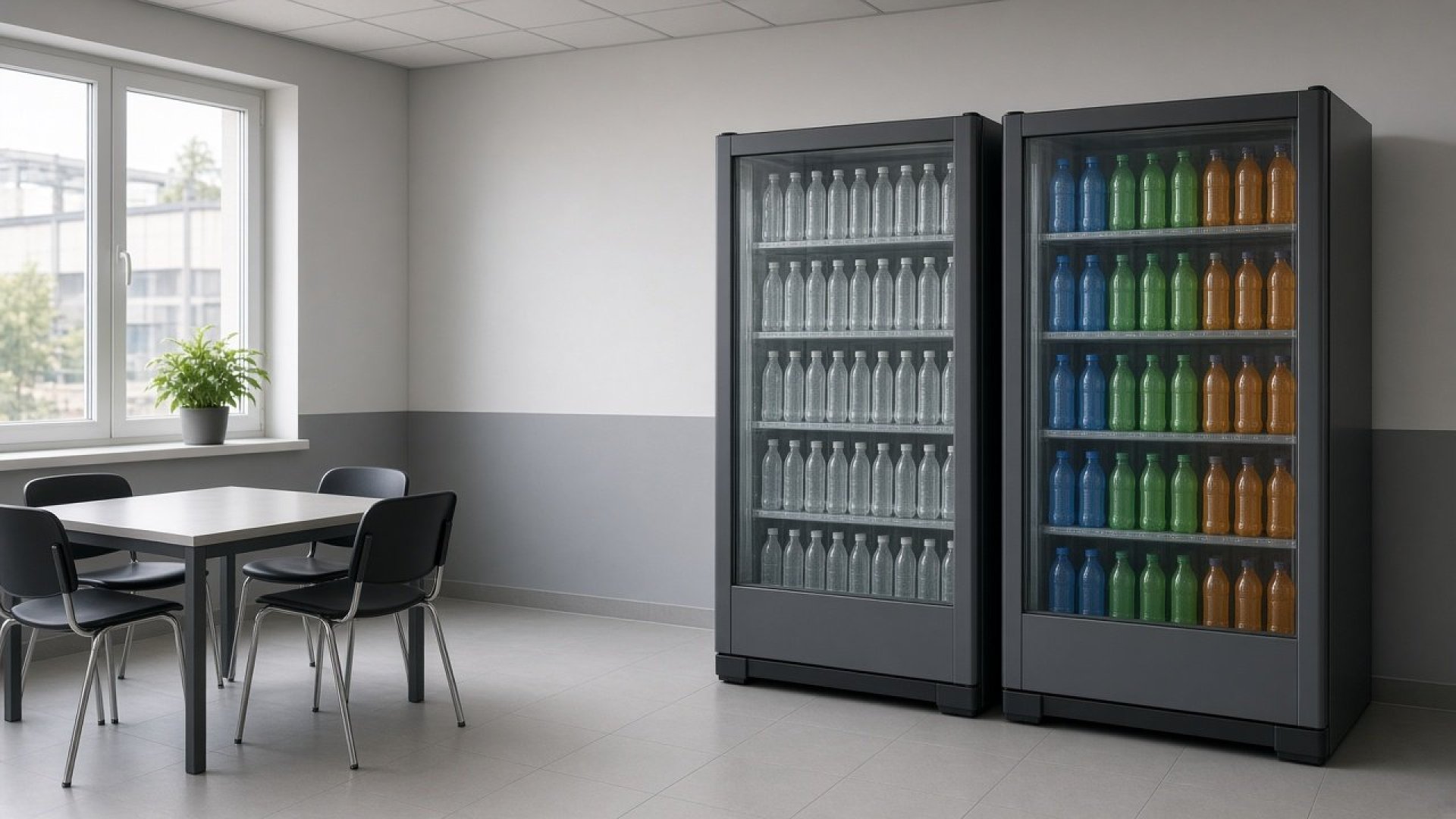
| Can and bottle drink machine | Bottled water, tea, ready-to-drink beverages | Needs chilling and free space for heat to escape |
| Water and coffee dispenser (ตู้กดน้ำ, ตู้กดกาแฟ) | Hot or cold drinks made inside the unit | Needs a water supply, drainage and a cleaning routine |
| Food vending machine (ตู้อาหารอัตโนมัติ) | Boxed meals or ready-to-eat chilled food | Short shelf time, so temperature and reheating must be clearly controlled |
The two teams that decide see different benefits.
- HR: employees can buy a drink or a snack in a short break without leaving the site, and night-shift colleagues get an option too.
- Procurement: with a written agreement, it is clear who is responsible for installation, repairs, restocking and reports.
How do you choose a location for a vending machine in a factory?
Place the machine close to where employees already spend their break, such as outside the canteen, in a rest area or on a busy walkway, without blocking fire exits and away from production areas with dust or high humidity.
- Look at real walking routes: watch where each shift goes for its break and put the machine on that route.
- Keep walkways and fire exits clear: the machine must not hide signs or safety equipment, and people must still be able to pass each other. Have the factory's safety officer review the layout first.
- Think about the night shift: if the spot is dim or too quiet at night, night-shift employees may not use it.
What power and space does a vending machine need?
You need a power point that suits the machine's load, a level floor that can carry its weight, and clear space around it for ventilation and for opening the door to restock. Exact requirements must come from the machine's manual and an electrician's check.
- Power: confirm that the circuit at that spot can take the machine's load, that it is earthed and protected by a cut-off, and that it does not rely on a chain of extension leads.
- Space: leave room behind and beside the machine so heat can escape, and in front so users can choose without blocking the walkway.
- Water and drainage: a water or coffee dispenser needs a suitable water inlet and a place for waste water to drain.
How should you plan the product mix around the shifts?
Start with what employees buy often during a break, then adapt by shift, for example drinks and light snacks for the morning shift, ready-to-eat items for the afternoon, and hot drinks for the night shift.
- Ask real employees: use a short survey and adjust the range on a schedule; see employee canteen satisfaction survey for ideas.
- Plan by shift: the night shift often has fewer food choices than the day shift; see meals for shift workers for ideas on each shift.
- Think about dietary differences: include options for halal and vegetarian colleagues; see halal and vegetarian options for staff.
- Specially regulated goods: check the law and your organisation's policy before stocking them.
How do you restock a vending machine and check expiry dates?
Set the restocking round from real sales data, fill before each shift's break, and use first-in first-out (FIFO) so older stock is picked first.
- Use the sales data: slots that sell out fast need refilling more often, and slow slots can hold less or carry a different product.
- Check expiry dates every round: remove near-expiry goods before the date according to your organisation's criteria, and note how they were handled.
- Provide a way to report problems: put contact details on or beside the machine so employees can report a stuck item or a payment that did not match, and agree with the provider how refunds work.
The ideas of stock rotation and counting are similar to running a factory shop; see the guide to factory minimart management for more detail.

What cleaning and maintenance does a vending machine need?
Look after the outside of the machine, the collection tray, the shelves, the chilling system and the area around it, and decide who cleans, how often, and who checks for faults.
- Wipe frequently touched points such as buttons and the collection tray on a set schedule, and clean the shelves when restocking.
- Check that a chilled machine is still cold, and tell the provider at once about unusual noises or dripping.
- Put a bin in a sensible spot near the machine and name who empties it; see the canteen daily food safety checklist for other checks.
What payment options do vending machines offer?
Common options are coins and notes, QR code payment, e-wallet apps and a staff card tied to a company system, chosen to suit employees and the organisation's readiness.
- QR code and e-wallets: less cash to handle, but incoming payments should be reconciled with the machine's sales on a schedule.
- Staff card or payroll deduction: consult accounting, legal advice and organisation policy first, and protect employees' personal data properly.
How is a vending machine different from a minimart or a pantry?
A vending machine takes little space and works all day without a shop assistant, a minimart offers a wider range of goods, and a pantry is a drinks and snacks corner that the organisation provides for employees to help themselves.
| Format | Strengths | Limits |
|---|---|---|
| Vending machine | Small footprint, no dedicated staff, available all day | Range limited by slots, needs a restocking round and machine care |
| Minimart | Wide range, easy to adjust | Needs a shop keeper, stock counts and opening hours |
| Pantry | Suits drinks and snacks provided as a benefit | Needs a budget and steady cleaning |
A factory with several shifts may add a vending machine for the hours when the minimart is closed, such as the night shift. See canteen management for factories, hospitals and international schools for an overview of shops and canteens in different places.
What should you ask a vending provider before signing?
Ask clearly who owns the machine, who installs and restocks it, how fast faults are handled, how space or electricity is charged, and how the machine is removed when the agreement ends. Then write every point into the agreement and have your legal team review it.
- Ownership and installation: who owns the machine and the goods inside, and who pays to install, move and remove it.
- Restocking: how often the round runs, how you report an empty slot before the round, and how unsold products are swapped.
- Repairs and reporting: contact channel, response time, and how employees are refunded when the machine does not dispense.
- Electricity and space fees: who pays for electricity, and whether any space fee applies.
- Liability and ending the agreement: who is responsible when the machine or goods are damaged, and the terms for ending or moving the machine.
The same thinking applies to writing service requirements and comparing providers; see the guide to outsourcing canteen management for HR and procurement and how to choose a canteen caterer.
Frequently asked questions about factory vending machines
Where should planning for a factory vending machine start?
Start by deciding whether it is a welfare benefit or an added service, then look at the location, power and space. After that, choose products employees buy often and agree who restocks and looks after the machine.
How often should a vending machine be restocked?
It depends on the number of employees and how each slot sells. Fill before each shift's break and adjust the round using real sales data.
Should you choose a vending machine, a minimart or a pantry?
If you want a small footprint and service all day, a vending machine is the natural fit. If you need a wide range with someone in charge, a minimart fits better, and a pantry suits drinks and snacks in an office. Many organisations mix them by shift and area.
Does TJ FAVOR GROUP offer vending machines?
Our website does not list vending machines as a main service, and this article is general guidance that does not describe the company's internal procedures. If your organisation is interested in staff food and drinks welfare, our team is happy to give initial advice.
Talk to TJ FAVOR GROUP about canteens and staff welfare
TJ FAVOR GROUP is a canteen management and catering company in Bangkok with more than seven years of restaurant experience. If your organisation wants to review food and drinks welfare in a factory or office, our team is ready to listen and give initial advice.
- LINE: @tjfavor (including the @)
- Phone: 063-878-8169 / 087-746-0044 / 096-949-6622
- Website: tjfavor.com
See our canteen management page, about us, or contact the team.