Canteen Hygiene Standards in Thailand: The 2018 Ministerial Regulation, the 75-Item Inspection Form, SAN, GREEN Canteen, GMP and HACCP Explained
Key takeaways
- The main law is the Ministerial Regulation on Sanitary Requirements of Food Sale Premises B.E. 2561 (2018) (กฎกระทรวงสุขลักษณะของสถานที่จำหน่ายอาหาร พ.ศ. 2561). The Department of Health has a 75-item canteen inspection form in 5 categories.
- Clean Food Good Taste was discontinued on 30 September 2023 (B.E. 2566). The Department of Health now uses SAN / SAN Plus instead.
- GMP is the baseline set of hygiene and production requirements, while HACCP is a system for analysing hazards and controlling critical points.
- Licensing, training and local requirements must always be confirmed with the local authority.
When a factory hires an outside company to run its canteen, one of the first questions from HR and safety teams is "what standards must the kitchen and service meet?" This article summarises the relevant standards and requirements, with sources from government agencies, as a framework for questions to put to every provider.
What standards must a factory canteen meet?
A canteen that counts as a food sale premises must comply with the Ministerial Regulation on Sanitary Requirements of Food Sale Premises B.E. 2561 (2018) (กฎกระทรวงสุขลักษณะของสถานที่จำหน่ายอาหาร พ.ศ. 2561), and the Department of Health (กรมอนามัย) has a food sanitation inspection form for canteens that it uses for assessments. GMP and HACCP are food safety system standards that a customer or a contract may require in addition.
Verify locally (ควรตรวจสอบ): The requirements that apply to your canteen depend on how it operates and on local rules. Confirm with the district office, municipality or subdistrict administrative organisation (อบต.) where you are located, and with your company's legal adviser.
The 2018 Ministerial Regulation and the 75-item canteen inspection form
The Department of Health's food sanitation inspection form for canteens is based on the Ministerial Regulation on Sanitary Requirements of Food Sale Premises B.E. 2561 (2018). It is used to inspect canteens in schools, factories, hospitals and other organisations. It has 75 items in 5 categories (source: Bureau of Food and Water Sanitation, Department of Health, foodsan.anamai.moph.go.th).
The 5 categories inspected
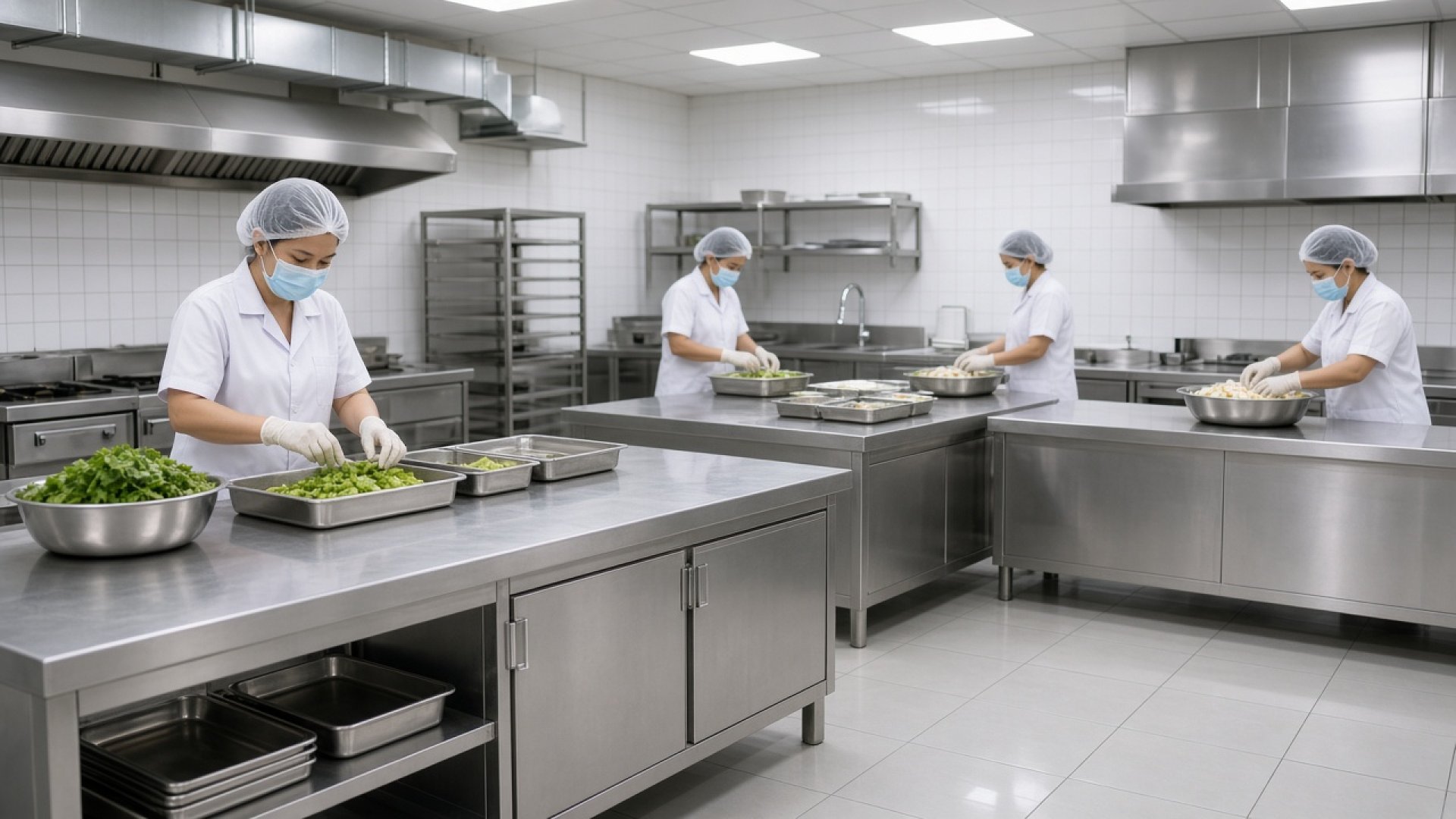
- Eating areas and areas for preparing, cooking and assembling food (35 items), for example clean floors and walls, hand-wash sinks with soap, preparation tables at least 60 cm above the floor, separate storage of chemicals, covered waste bins and a grease trap system
- Food and food storage methods
- Utensils and equipment
- Hygiene of supervisors and food handlers
- Food sanitation surveillance
Note: the item count for category 1 comes from the version of the form that could be opened and read. For the other categories, check the latest form from the Department of Health directly.
Premises over or under 200 square metres
The inspection form asks you to state whether the area is "less than 200 square metres" or "more than 200 square metres", and whether there is a licence or a certificate of notification for establishing a food preparation and cooking premises from the local authority. According to the local authority documents we reviewed, premises over 200 square metres must apply for a licence, while premises of 200 square metres or less only need to notify.
Verify locally (ควรตรวจสอบ): The 200 square metre threshold and the process for applying for a licence or notifying the local authority may differ under each area's local ordinance. Check with the authority where the canteen is located (for example the district office in Bangkok, or the municipality or subdistrict administrative organisation (อบต.) in other provinces).
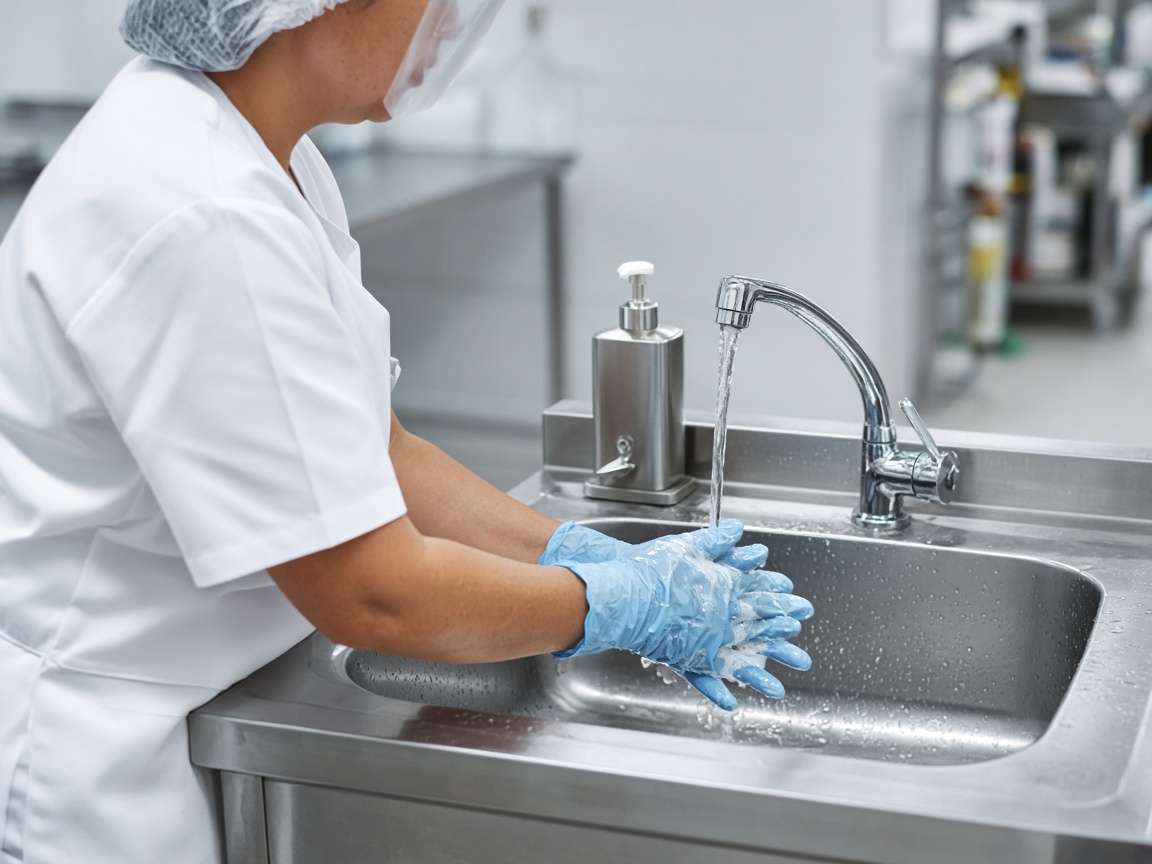 Correct handwashing by food handlers is one topic the inspection form emphasises (Illustrative image, not a photo of a client's kitchen)
What training do food handlers need?
Food handlers are people who prepare ingredients, cook, assemble, serve and sell food, and who wash utensils and equipment. The Department of Health's inspection form has fields to record the total number of food handlers and the number who have completed training. The course and the number of training hours follow the local authority's announcements.
Verify locally (ควรตรวจสอบ): Some local announcements we found specify a course of about 3 hours, but each area may set different requirements. Ask the public health office or the local authority in your area.
What are Clean Food Good Taste, SAN and GREEN Canteen?
Clean Food Good Taste was a Department of Health standard for clean, tasty food, and its certification was discontinued on 30 September 2023 (B.E. 2566). The Department of Health now uses the SAN and SAN Plus standards instead. GREEN Canteen is a Department of Health project for developing quality, clean and safe canteens.
SAN and SAN Plus
According to a Department of Health news item (13 June 2025, B.E. 2568), a food business that wants a SAN sign must do the following: 1) the operator and food handlers complete training; 2) hold a licence or a certificate of notification from the local administrative organisation; 3) self-assess hygiene under the 2018 Ministerial Regulation in the Foodhandler system; 4) have an officer assess and certify in the system; 5) once approved, print the SAN sign from the system, and upgrade to SAN Plus through the prescribed steps.
GREEN Canteen
This is a project of the Bureau of Food and Water Sanitation, Department of Health, on developing quality, clean and safe canteens. Canteen standard criteria documents are published on the Bureau's website.
Caution: a Clean Food Good Taste sign still displayed in a shop or canteen is no longer evidence of a current standard. If a provider cites this sign, ask about their current certification.
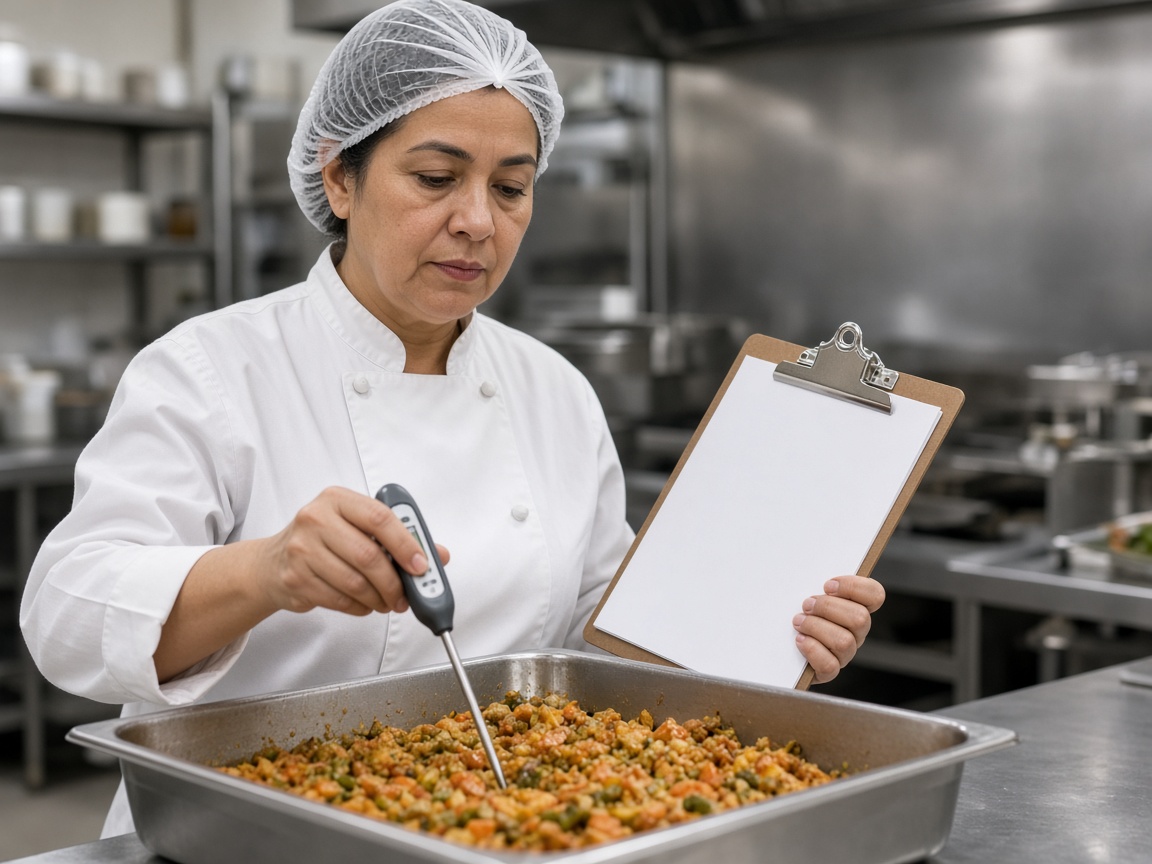 Checking hot food temperature and recording it is one example of a daily control (Illustrative image, not a photo of a client's kitchen)
What is the difference between GMP and HACCP?
GMP is the baseline set of requirements for premises, hygiene and production processes, while HACCP is a system for analysing hazards and controlling critical points. The Ministry of Industry states that GMP is the basic safety management system and is completed when HACCP is applied alongside it (source: industry.go.th/th/km/6550).
| Topic | GMP | HACCP |
|---|---|---|
| Full name | Good Manufacturing Practice | Hazard Analysis and Critical Control Point |
| Core idea | Baseline requirements for premises, equipment, personnel and hygiene | Analyse hazards at each step, then set critical control points and corrective actions |
| Examples of what is checked | Cleanliness of premises, control of insects and disease-carrying animals, personal hygiene | Control points such as cooking temperature, storage and record keeping |
| Relationship | The foundation that should be in place first | Added on top of GMP to control risk points systematically |
Verify locally (ควรตรวจสอบ): Whether a canteen must have GMP or HACCP, as a legal requirement or as a customer requirement, depends on the type of business and the contract. Check with the relevant authorities and your legal adviser.
How does our company control cleanliness and quality?
As stated in the canteen management article on our website, TJ FAVOR GROUP handles everything from menu planning and selecting fresh ingredients to managing the kitchen team and controlling food quality and cleanliness. It has a food quality and safety inspection system (Food Safety & Hygiene) and provides service under GMP and HACCP standards, with an after-sales team that listens to customer feedback to keep improving.
Whichever provider you choose, we recommend asking to see the following before you decide:
- The original certificates the provider refers to, with their scope and expiry date
- The team's food sanitation training records
- The cleaning schedule and the daily inspection forms
- The licence or certificate of notification from the local authority (if applicable)
- A visit to the actual kitchen and serving area
Frequently asked questions about canteen standards
What standards must a factory canteen meet?
A canteen that counts as a food sale premises must comply with the Ministerial Regulation on Sanitary Requirements of Food Sale Premises B.E. 2561 (2018) (กฎกระทรวงสุขลักษณะของสถานที่จำหน่ายอาหาร พ.ศ. 2561). The Department of Health has a 75-item, 5-category food sanitation inspection form for canteens that it uses for assessments. Please check the latest requirements with the local authority in your area.
Do food handlers need food sanitation training?
The Department of Health's inspection form counts the food handlers who have completed training, and the SAN certification process requires the operator and food handlers to complete training. The course and the number of hours may differ under local announcements, so please ask the authority in your area.
Does a canteen need a licence?
According to local authority documents, a food sale premises of more than 200 square metres must apply for a licence, while premises of 200 square metres or less must notify the local authority. Please check this information again with the district office, municipality or subdistrict administrative organisation (อบต.) in your area.
What is the difference between GMP and HACCP?
GMP is the baseline set of requirements for premises, hygiene and food production processes, while HACCP is a system for analysing hazards and setting critical control points at each step. The Ministry of Industry explains that GMP is the basic system, and safety is completed when HACCP is used alongside it.
Is Clean Food Good Taste still in use?
The Department of Health discontinued Clean Food Good Taste certification on 30 September 2023 (B.E. 2566) and uses the SAN and SAN Plus standards instead, according to its news item of 13 June 2025 (B.E. 2568).
What is GREEN Canteen?
GREEN Canteen is a project of the Bureau of Food and Water Sanitation, Department of Health, on developing quality, clean and safe canteens. Canteen standard criteria are published on the Bureau's website. Please check the latest criteria on that website.
References
- Department of Health: food sanitation inspection form for canteens (under the Ministerial Regulation on Sanitary Requirements of Food Sale Premises B.E. 2561) foodsan.anamai.moph.go.th
- Department of Health: news item "Department of Health promotes SAN - SAN Plus standards to replace Clean Food Good Taste" (13 June 2025) multimedia.anamai.moph.go.th/news/130668/
- Bureau of Food and Water Sanitation, Department of Health: developing quality, clean and safe canteens (GREEN Canteen) foodsan.anamai.moph.go.th/th/green-canteen/
- Ministry of Industry: production standards for the food industry (GMP, HACCP) industry.go.th/th/km/6550
Request a canteen management quote from TJ FAVOR GROUP
If your factory or organisation has 100 or more employees and you are looking for a canteen management provider, send us your headcount, number of meals and location. Our team will assess your needs and prepare a quote that suits your project. We are happy to answer questions about how we look after cleanliness and food quality in your canteen.
- LINE: @tjfavor (including the @) or @tjfavorcatering
- Phone: 098-415-2738 / 087-746-0044 / 063-878-8169 / 085-099-1092
- Email: tjfavorgroup@gmail.com
- Address: 277 Soi Rongrian Khlong Lamchiak, Khlong Chan, Bang Kapi, Bangkok 10240
See details on our canteen management service page (Thai) or contact the team.
Related reading